
Why Healthcare Facilities Are Turning to Advanced Disinfection Solutions
Automated disinfection technology represents a shift in how healthcare facilities combat the persistent threat of hospital-acquired infections. These advanced systems use proven methods like powerful UV-C light to eliminate pathogens, moving beyond manual processes that are prone to human error and inconsistency.
The numbers tell a compelling story. At least 1 out of 25 patients are at risk of hospital-acquired infections in the United States, while contaminated surfaces contribute significantly to pathogen transmission. Subsequent room occupants face approximately double the risk of acquiring infections from previous patients.
As Dr. Robert Weinstein noted: “Given the choice of improving technology or improving human behavior, technology is the better choice.” This insight captures why forward-thinking healthcare facilities are investing in automated solutions that remove human variability from critical disinfection processes.
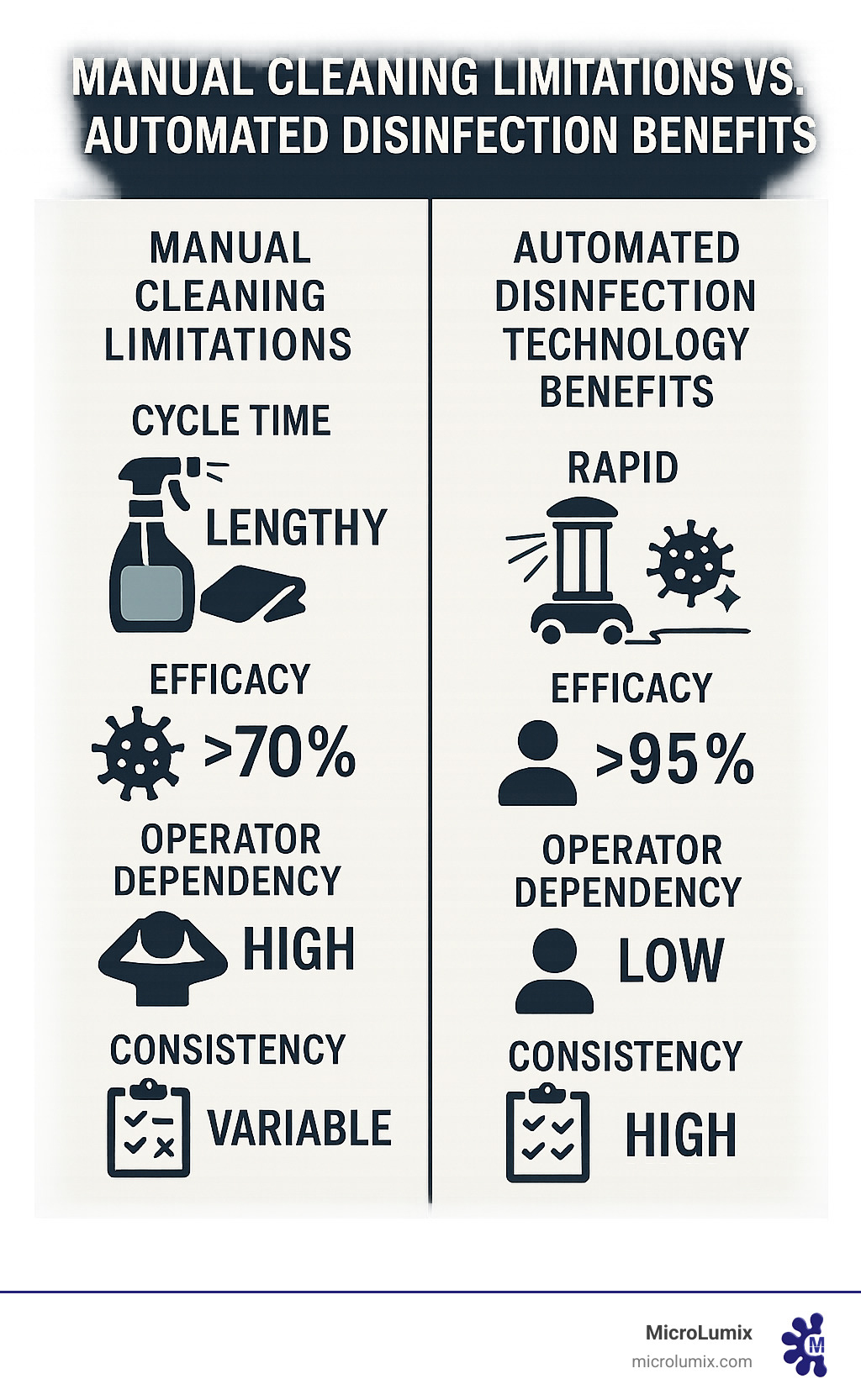
Manual disinfection faces inherent limitations—time constraints, inconsistent application, and the reality that some pathogens like C. difficile spores resist standard chemical disinfectants. Automated disinfection technology addresses these gaps by delivering consistent, measurable, and verifiable pathogen elimination.
I’m Debra Vanderhoff, Founder and COO of MicroLumix Bioscience Technology, where we’ve spent years developing chemical-free automated disinfection technology solutions for healthcare environments. My background spans over 20 years in biotechnology and operations, focused on creating systems that improve public health while streamlining facility workflows.
The Persistent Challenge of Manual Disinfection
Manual disinfection in healthcare has long been an uphill battle. Environmental services (EVS) staff work incredibly hard, but manual methods face serious challenges that can put patients and staff at risk.
Human error is the biggest hurdle, leading to the silent enemy of infection control: inconsistency. When staff are tired or rushed, the same procedure can vary significantly. One day, a frequently-touched bed rail gets thorough attention; the next, it might not. Studies have found MRSA on 66% of surfaces in patient rooms even after terminal cleaning, a sobering reminder that good intentions don’t always yield consistent results.
The labor-intensive nature of manual disinfection, combined with time constraints, creates more problems. With pressure mounting for faster room turnovers, quality can be sacrificed for speed. Pathogens like Clostridium difficile spores require specific agents and longer contact times, but these critical steps are often cut short when time is tight.
Manual cleaning also struggles with inadequate reach. Tight corners, the undersides of furniture, and intricate device surfaces are often missed entirely, creating hidden reservoirs for pathogens.
Furthermore, repeated chemical exposure can cause skin irritation and respiratory issues for the very staff working to keep facilities safe. This is compounded by pathogen resilience. Some microbes, like C. difficile spores, are resistant to common disinfectants. Biofilms, protective communities of microorganisms, can shield bacteria from cleaning agents, making them nearly impossible to eliminate with manual methods alone.
The CDC provides comprehensive scientific research on disinfection guidelines that highlight these challenges.
While manual cleaning is essential for removing visible soil, these limitations show why we need something more. This is where automated disinfection technology becomes a game-changer, providing the consistent, thorough disinfection that manual methods struggle to achieve.
A Guide to Automated Disinfection Technology Systems

The shift to automated disinfection technology is about solving the core issues of human error, inconsistency, and time constraints. Terminal disinfection—the deep clean after a patient leaves—becomes dramatically more reliable when you remove human variables. Automated systems deliver consistent, measurable results every time, standardizing protocols across an entire facility and improving patient safety.
MicroLumix Advanced Disinfection Technology
Our GermPass system takes a completely different approach. Instead of waiting for a terminal clean, we tackle contamination at its source—the moment it happens.
Our mechanism of action centers on self-sealing UVC chambers integrated directly into high-touch surfaces. The moment contact ends, our system immediately sanitizes that exact spot, ensuring it’s clean for the next person. This targeted surface disinfection also addresses airborne pathogens in the immediate area around each touchpoint.
When it comes to efficacy against resilient pathogens, our numbers speak for themselves. We achieve a 99.999% reduction against even the toughest superbugs, including stubborn Clostridium difficile spores, MRSA, and VRE.
Fast cycle times become irrelevant when disinfection is instantaneous and continuous. Our touchpoint technology works in real-time with no waiting, no scheduling conflicts, and no impact on patient flow.
Our chemical-free process eliminates concerns about chemical exposure for staff, material degradation from harsh disinfectants, and residue left on surfaces. It’s clean technology in every sense.
The design minimizes shadowing and maximizes coverage by bringing disinfection directly to each touchpoint. No shadows, no missed spots. Smart sensors and adaptive operation make our system truly intelligent, responding to actual contamination events as they happen.
This technology transforms your entire approach to infection control. Instead of playing defense, you’re preventing transmission at the exact moment it would happen. That’s the future of automated disinfection technology.
Implementing and Validating Automated Systems in Hospitals
Successfully bringing automated disinfection technology into your hospital is about weaving a new layer of protection into your existing infection control efforts. The most successful implementations happen when hospitals approach this as a strategic partnership.

Practical Considerations for Successful Integration
Successful integration hinges on how well the technology fits with existing workflows.
- Workflow analysis is our starting point. We work with your team to map current processes, identify bottlenecks, and find optimal placements for our touchpoint systems to complement your manual cleaning.
- Staff training and education are critical. We empower your staff with comprehensive training so they understand how the system works and why it matters for infection prevention.
- Room preparation protocols are simplified with our touchpoint system. Because GermPass integrates directly into high-touch surfaces, it requires minimal special preparation beyond your standard cleaning protocols.
- Selecting technology for specific spaces requires assessing unique needs like room layout and surface materials. Our touchpoint system solves the problem of distance and shadowing by bringing disinfection directly to the surface.
- Turnaround time impact is eliminated. Our technology provides continuous, real-time disinfection without any downtime, improving efficiency and patient flow.
- Integration with Environmental Services should empower your EVS team. Automated systems are advanced tools that improve their capabilities, freeing them to focus on detailed cleaning work.
Safety Protocols in Patient Care Environments
In healthcare, safety is everything. Operator safety is built into our system from the ground up. Our UV-C touchpoint system operates within a completely self-contained, self-sealing chamber, meaning zero direct UV-C exposure to operators or patients. This design eliminates the need for complex safety protocols like remote operation or room sealing. We’ve also extensively tested our technology for material compatibility to ensure it won’t damage the surfaces and equipment you’re trying to protect.
The Role of Data in Validating Your Automated Disinfection Technology
Data-driven decisions are essential for proving effectiveness and maintaining compliance.
- Data tracking and wireless reporting turn subjective cleaning into an objective, measurable process. Our systems provide digitally auditable disinfection records for monitoring compliance.
- Cycle validation and efficacy measurement give you confidence that your investment is working. Our GermPass system’s lab-certified status provides inherent validation of its 99.999% efficacy.
- Calculating ROI and measuring reduced HAI rates is the ultimate validation. By correlating disinfection data with healthcare-associated infection rates, you can directly measure the impact. Reduced infections translate into significant cost savings and improved patient outcomes. For more insights into the ongoing battle against hospital infections, you can explore this resource: More info about infection prevention.
The Next Generation of Disinfection
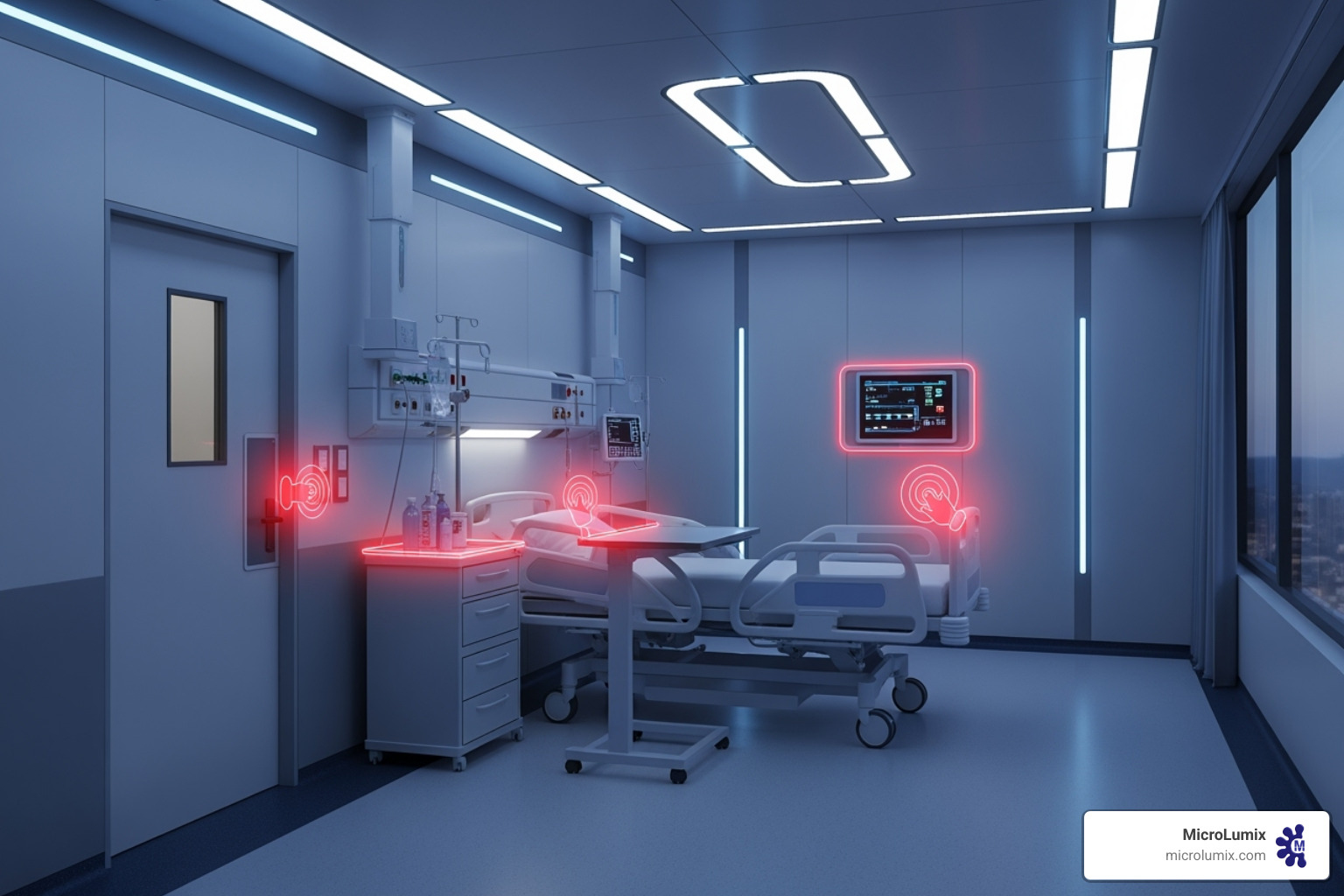
The future of automated disinfection technology is about creating smarter, more responsive healthcare environments.
Increased autonomy is a key development on the horizon. Picture smart, autonomous systems that learn a facility’s layout, identify high-risk areas, and adapt disinfection schedules accordingly without human guidance. The integration of AI-driven analysis will take this further, allowing systems to predict where infections are likely to occur and deploy resources proactively.
Smart room sensors are also becoming more sophisticated. While our GermPass system already uses intelligent sensors to detect touch events, the next generation will provide even more detailed environmental data, triggering disinfection cycles with greater precision.
Integration with hospital IT systems is already beginning. Soon, disinfection data will flow seamlessly into electronic health records and facility management platforms. This holistic view will help hospitals make smarter decisions about resource allocation and infection prevention strategies.
The shift toward continuous disinfection represents a fundamental change in how we think about cleanliness. Our GermPass system is pioneering this approach with touchpoint sanitation that happens immediately after every touch. This model of maintaining a constant state of hygiene significantly reduces the window of opportunity for pathogen transmission, protecting both patients and healthcare workers more effectively than ever before.
Frequently Asked Questions about Automated Disinfection
When hospitals consider implementing automated disinfection technology, they naturally have questions. Let me address the most common concerns.
Is automated disinfection a replacement for manual cleaning?
No, absolutely not. Automated disinfection technology is a powerful partner to manual cleaning, not a replacement. Manual cleaning is essential for removing visible dirt and organic matter. Automation then provides a consistent, high level of disinfection that is difficult to achieve manually. Our GermPass system, for instance, continuously disinfects touchpoints, but it’s most effective in a regularly cleaned environment. This multi-layered strategy creates the most robust defense against healthcare-associated infections.
How effective are these systems against superbugs like MRSA and C. diff?
They are highly effective. Our MicroLumix GermPass system achieves 99.999% efficacy against a broad spectrum of pathogens, including notorious superbugs like Methicillin-resistant Staphylococcus aureus (MRSA) and Clostridium difficile (C. diff) spores. The UV-C light damages the DNA of these microorganisms, making it impossible for them to reproduce and cause infections. This high level of pathogen reduction directly translates to reduced transmission rates in healthcare facilities.
What is the biggest challenge when implementing this technology?
From our experience, the biggest problems are human, not technical. Workflow integration and staff buy-in are the most significant challenges, but they are manageable with the right approach. We work closely with hospitals to ensure our technology improves workflows rather than disrupting them. With proper training, staff often become our biggest advocates once they see how the technology makes their jobs easier and safer.
The initial capital investment can seem daunting, but preventing even a few expensive healthcare-associated infections can quickly justify the cost. We help hospitals analyze the numbers to see the real return on investment. Choosing the right system is also key, which is why we partner with each facility to find the solution that best fits their unique needs.
Conclusion: Embracing a New Standard of Clean
The journey through this guide reveals a powerful truth: healthcare hygiene is undergoing a fundamental change. We’ve seen how manual disinfection, despite the dedication of healthcare workers, faces limitations that put people at risk. With 1 out of 25 patients facing the threat of a healthcare-associated infection, we cannot rely solely on traditional methods.
Automated disinfection technology is a game-changer that addresses the core challenges of human error, inconsistency, and the threat of superbugs. Systems that achieve 99.999% pathogen reduction are creating a new standard of protection.
The benefits are clear: improved patient and staff safety, better infection control outcomes, and greater operational efficiency. When EVS staff can focus on essential cleaning while automation handles microscopic threats, everyone wins.
The future belongs to continuous, targeted systems. Our MicroLumix GermPass system embodies this vision with touchpoint sanitation that happens immediately after every touch, creating an environment where pathogens cannot spread.
This isn’t about replacing the human element in healthcare; it’s about empowering it. By removing the variables that lead to infection, we create space for healthcare workers to focus on what they do best: caring for patients.
This shift represents a commitment to the safety and wellbeing of everyone in a healthcare facility. The technology delivers on its promises, and the future points toward even smarter, more integrated solutions.
We’re excited to be part of this change and to work alongside healthcare facilities that share our vision for a safer, cleaner future. The question isn’t whether to adopt automated disinfection technology—it’s how quickly you can implement it to protect the patients and staff who depend on you.