
Why Healthcare Facility Disinfection is Your First Line of Defense
Healthcare facility disinfection is the systematic process of eliminating harmful microorganisms from medical environments to prevent healthcare-associated infections (HAIs) and protect both patients and staff. HAIs are a significant threat to patient safety, with the CDC estimating that on any given day, about one in 31 hospital patients has at least one healthcare-associated infection. These infections can lead to severe illness, longer hospital stays, and increased medical costs, making their prevention a top priority. With approximately 46.5 million surgical procedures performed annually in the U.S. alone, the need for stringent, effective disinfection protocols has never been more critical.
Quick Implementation Guide for Healthcare Facility Disinfection:
- Clean first – The non-negotiable first step is to physically remove all visible soil, debris, and organic matter (like blood or tissue) before applying a disinfectant. Cleaning with detergents and water physically removes a large number of microorganisms and eliminates substances that can interfere with or inactivate the disinfectant.
- Choose the right level – Not all items require the same level of decontamination. Use sterilization for critical items that enter sterile tissue, high-level disinfection for semicritical items that contact mucous membranes, and low-level disinfection for non-critical surfaces like bed rails and floors. This risk-based approach, known as Spaulding’s Classification, ensures safety without unnecessary cost or equipment wear.
- Follow manufacturer instructions – Always use EPA-registered disinfectants according to their specific label directions. This includes correct dilution, application method, and, most importantly, contact time—the period the surface must remain wet to achieve germ-killing efficacy. Deviating from these instructions can render the product ineffective.
- Train your team – Comprehensive training is essential for everyone involved, from environmental services (EVS) staff to clinical personnel who handle equipment. Ensure all staff complete recognized certification courses and receive ongoing education on new products, protocols, and equipment. Competency must be regularly assessed.
- Monitor quality – A disinfection program is only as good as its results. Implement a regular auditing system to verify compliance and effectiveness. This can include visual inspections, fluorescent markers to check cleaning thoroughness, and the use of biological and chemical indicators to confirm that sterilization and disinfection equipment is functioning correctly.
- Document everything – Maintain clear, detailed written policies and procedures for all disinfection and sterilization processes. These documents should be reviewed at least annually by the facility’s infection control committee and be readily accessible to staff. Meticulous records are crucial for regulatory compliance, quality assurance, and outbreak investigations.
The primary goals of healthcare facility disinfection are straightforward: prevent transmission of microorganisms to patients and staff, and minimize equipment damage from contamination or improper handling. However, achieving these goals requires understanding that cleaning must always precede disinfection or sterilization – soil can physically shield microorganisms and chemically inactivate disinfectants, rendering the entire process useless.
Modern healthcare facilities need a multi-layered approach that breaks the chain of infection at multiple points. This chain consists of a pathogen, a reservoir (like a contaminated surface), a mode of transmission, and a susceptible host. Effective disinfection eliminates the reservoir and blocks the mode of transmission. This isn’t just about compliance—studies show that failure to follow proper disinfection guidelines has led to numerous preventable healthcare-associated outbreaks.
I’m Debra Vanderhoff, Founder and COO of MicroLumix Bioscience Technology, where I’ve spent over 20 years developing automated disinfection systems for healthcare environments. My experience in healthcare facility disinfection spans from manual protocols to cutting-edge chemical-free decontamination technology that creates safer environments for millions of people worldwide.
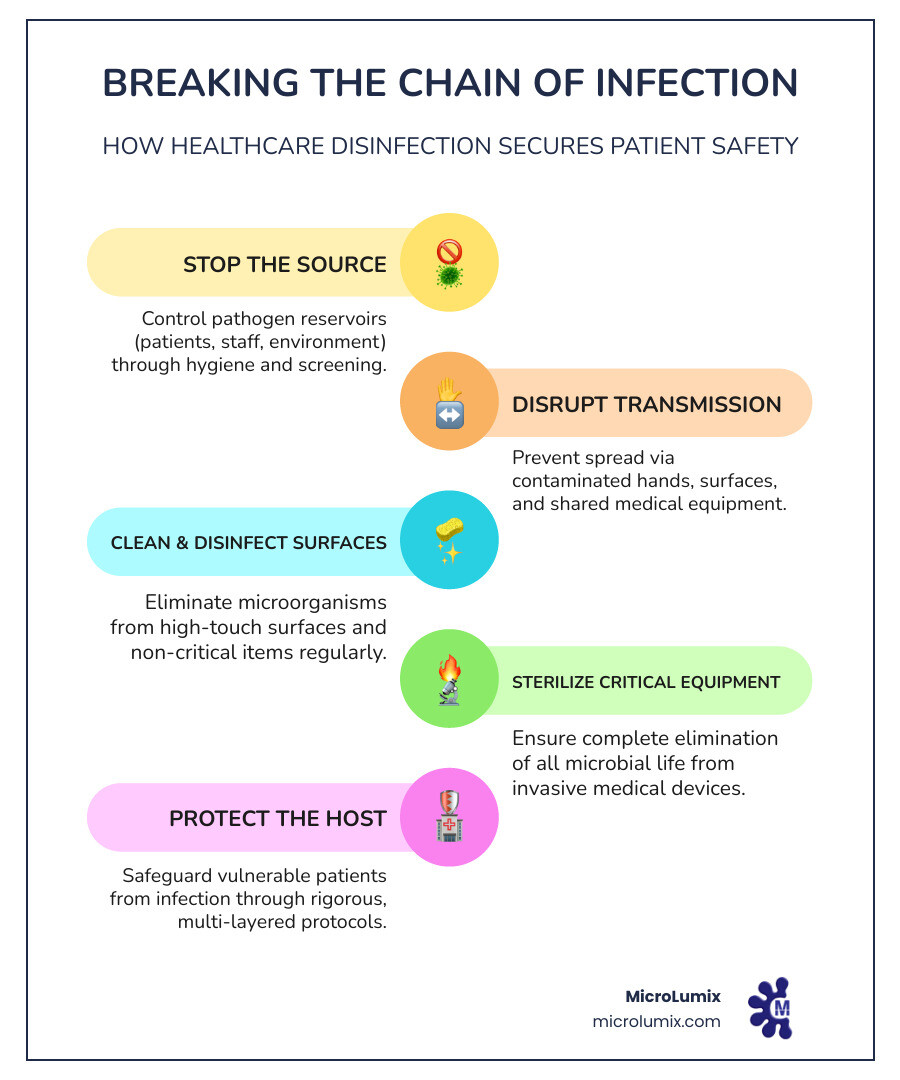
To make this actionable, here is what good looks like in day-to-day operations:
- Before each patient encounter: perform hand hygiene, wipe stethoscopes and mobile device touch surfaces, and verify that the disinfectant’s required wet contact time can be met.
- Between-room turnover: remove waste and linen; clean, then disinfect high-touch points (bed rails, overbed tables, call buttons, IV pumps, monitors) and allow full label contact time; document completion in the room log.
- End-of-day terminal cleaning: use a ceiling-to-floor approach, inspect and launder or replace privacy curtains as indicated, and replenish hand hygiene and PPE supplies.
- Isolation rooms: dedicate tools and carts; use products with sporicidal claims where indicated (for organisms like C. difficile); apply extended dwell times as specified on the product label.
- Transporting contaminated items: bag and label at point of use, use rigid, leak-proof containers, and route directly to reprocessing without unnecessary stops.
Being survey-ready also means your documentation is ironclad. Maintain device tracking logs, lot numbers for disinfectants and sterilants, equipment cycle printouts, biological and chemical indicator results, preventive maintenance records, staff competency files, and policies that reflect current practice. Clear documentation shortens survey time and helps prevent citations.
Finally, technology should complement, not replace, your people and processes. Automated adjuncts—such as self-sealing UVC chambers that sanitize handles and buttons immediately after each touch—reduce bioburden between manual cleaning rounds, standardize outcomes in high-traffic zones, and reinforce your multi-layered defense. Solutions like MicroLumix’s Automated Disinfection Technology support frontline teams by closing gaps where manual workflows are hardest to sustain at peak volumes.
The Core Principles: Cleaning, Disinfection, and Sterilization
Think of healthcare facility disinfection like preparing for surgery – you wouldn’t just spray disinfectant on dirty hands and call it good. There’s a specific order to follow, and each step builds on the previous one.
The confusion between cleaning, disinfection, and sterilization causes more problems in healthcare than you might imagine. I’ve seen facilities spend thousands on high-end disinfectants, only to have them fail because staff skipped the crucial cleaning step first. Let’s break down these fundamental processes.
Here’s what each process actually does:
| Process | Purpose | Method | Items Used On |
|---|---|---|---|
| Cleaning | Removes visible soil and reduces microbial load | Physical removal with detergent and water | All items before disinfection |
| Low-Level Disinfection | Kills most vegetative bacteria and viruses | EPA-registered disinfectants | Non-critical items (surfaces, equipment) |
| High-Level Disinfection | Destroys all microorganisms except bacterial spores | Chemical immersion or automated systems | Semicritical items (endoscopes, respiratory equipment) |
| Sterilization | Complete elimination of all microbial life | Steam, ethylene oxide, or hydrogen peroxide | Critical items (surgical instruments, implants) |
Cleaning must always come first – this isn’t just a suggestion; it’s a scientific necessity. Soil and organic matter like blood, tissue, and feces can chemically neutralize active ingredients in disinfectants and physically shield pathogens from contact. The process of cleaning involves friction (scrubbing, wiping) and the use of detergents, often enzymatic ones, which break down proteins and fats. This step removes the bioburden, allowing the subsequent disinfectant or sterilant to do its job effectively.
The different disinfection levels exist because not everything in healthcare carries the same infection risk. A stethoscope that touches intact skin needs different treatment than a bronchoscope that enters sterile body areas.
- Low-Level Disinfection is used for non-critical items and surfaces that contact intact skin. This includes bed rails, overbed tables, IV poles, floors, and walls. The disinfectants used, such as quaternary ammonium compounds (Quats), are effective against most vegetative bacteria and enveloped viruses (like influenza) but cannot be relied upon to kill resilient pathogens like bacterial spores or mycobacteria.
- Intermediate-Level Disinfection is a step up, capable of killing mycobacteria (the organism that causes tuberculosis), which is a benchmark for disinfectant efficacy. It’s used for some non-critical items that may be contaminated with more resistant pathogens. Alcohol-based disinfectants are a common example.
- High-Level Disinfection (HLD) is required for semicritical items. This process destroys all vegetative bacteria, mycobacteria, fungi, and viruses, but not necessarily high numbers of bacterial spores. Common HLD methods involve immersing a pre-cleaned device in a chemical solution like glutaraldehyde, ortho-phthalaldehyde (OPA), or peracetic acid for a specific time and temperature. After HLD, items must be rinsed thoroughly with sterile or filtered water to remove chemical residues.
Sterilization is the gold standard—the complete destruction of all microbial life, including the tough bacterial spores that can survive high-level disinfection. Because it provides the highest margin of safety, sterilization is reserved for critical items that will enter sterile parts of the body. Common methods include:
- Steam Sterilization (Autoclaving): Uses pressurized, high-temperature steam to kill microbes. It’s fast, effective, non-toxic, and inexpensive, making it the preferred method for heat-tolerant instruments.
- Ethylene Oxide (EtO) Gas: A low-temperature process used for items sensitive to heat and moisture, such as complex electronics or plastics. While effective, EtO is toxic and requires a long aeration period to remove residual gas.
- Hydrogen Peroxide Gas Plasma: Another low-temperature method that is faster and safer than EtO. It uses hydrogen peroxide vapor energized into a plasma state to sterilize heat-sensitive instruments.
This is where Spaulding’s Classification becomes your best friend. Dr. Earle Spaulding developed this logical framework in the 1960s, and it remains the foundation for modern disinfection and sterilization policies. It groups medical items by infection risk:
- Critical items enter sterile body areas or the bloodstream. Examples include surgical instruments, cardiac catheters, implants, and biopsy forceps. These items demand sterilization, with no exceptions.
- Semicritical items touch mucous membranes or non-intact skin but don’t penetrate sterile tissue. This category includes endoscopes, respiratory therapy equipment, anesthesia circuits, and vaginal speculums. These require, at a minimum, high-level disinfection.
- Non-critical items only contact intact skin, which acts as a natural barrier to most microbes. Examples are stethoscopes, blood pressure cuffs, bed rails, furniture, and computer keyboards. Low-level disinfection is sufficient for these items.
The beauty of this system is its simplicity and logic. By classifying an item, the required level of reprocessing becomes clear, preventing both dangerous under-processing and costly, damaging over-processing of sensitive equipment.
For detailed protocols and the latest updates, the CDC’s Guideline for Disinfection and Sterilization in Healthcare Facilities remains the definitive resource that every healthcare facility should reference.
Understanding these core principles isn’t just about following rules—it’s about creating a systematic, evidence-based approach that protects every patient and staff member who walks through your facility doors.