
Why Smart Hospital Technology is Changing Modern Healthcare
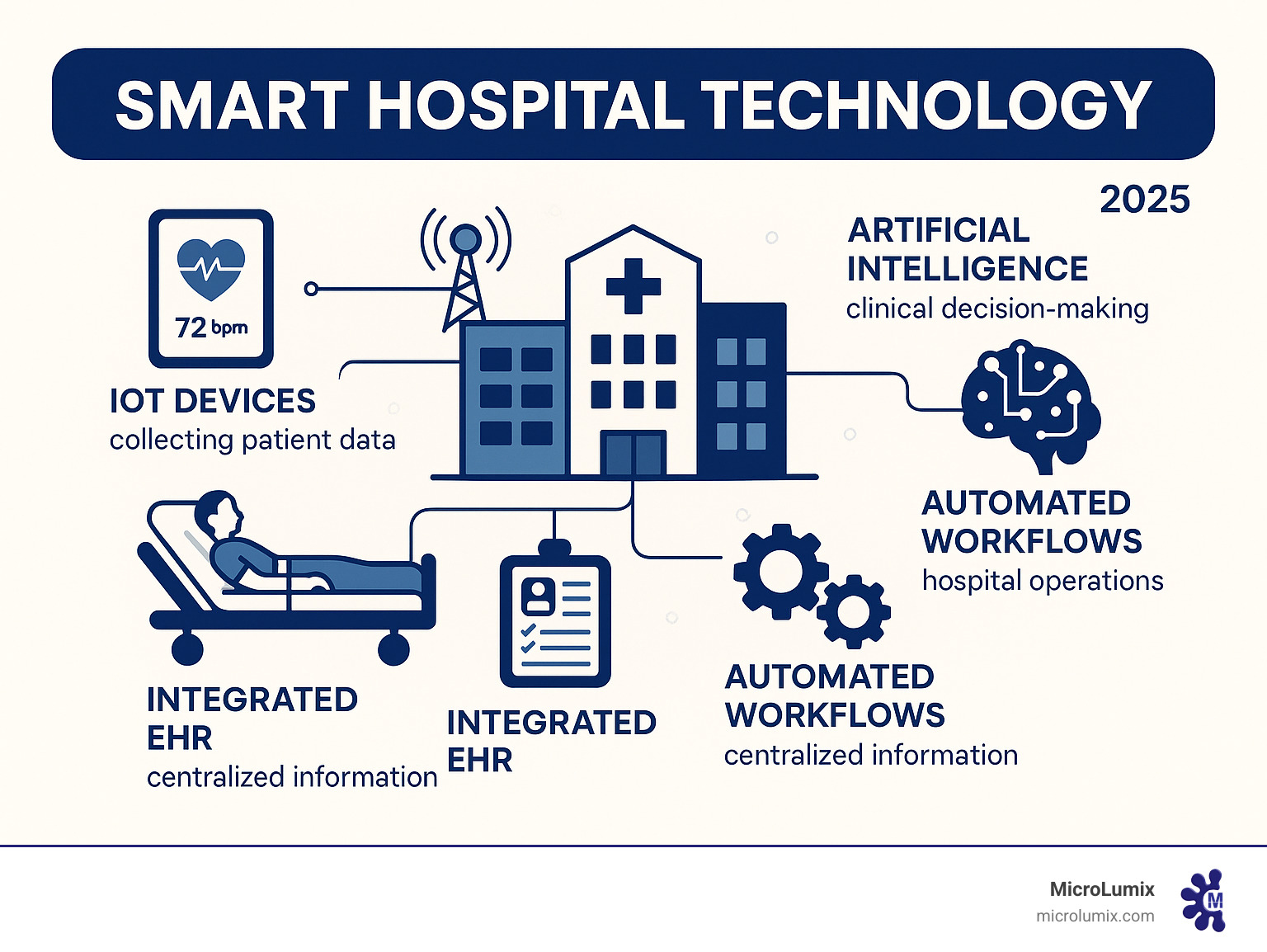
Smart hospital technology represents a new approach to healthcare that uses digital tools, artificial intelligence, and interconnected systems to create intelligent, responsive medical environments. By integrating IoT devices, AI analytics, and automated workflows, these facilities deliver personalized care while optimizing operational efficiency.
Key Components of Smart Hospital Technology:
- Connected Infrastructure: IoT sensors, smart beds, and wearables for real-time data collection.
- Artificial Intelligence: Predictive analytics, automated diagnostics, and clinical decision support.
- Integrated Platforms: Unified electronic health records (EHRs) that eliminate data silos.
- Automated Workflows: Streamlined processes for admissions, medication management, and more.
- Improved Connectivity: 5G and Wi-Fi 7 for instant data transfer.
As Cameron Love, President and CEO of The Ottawa Hospital, noted: “We believe that embracing innovation and technological improvement helps us provide better patient care and a better patient experience.”
This shift from reactive to proactive, data-driven care is a fundamental move toward patient-centered medicine. Smart hospitals improve the patient experience, personalize treatment, and minimize errors through automation and real-time monitoring.
I’m Debra Vanderhoff, Founder and COO of MicroLumix Bioscience Technology. For over four years, I’ve focused on developing automated disinfection systems that integrate with Smart hospital technology infrastructures. My experience has shown me how connected systems can revolutionize both patient safety and operational efficiency.
What Makes a Hospital ‘Smart’? From Traditional to Tech-Enabled
Imagine a hospital where your bed adjusts to prevent pressure sores, your nurse is alerted instantly to changes in your vital signs, and your care team has immediate access to your complete medical history. This is the reality of smart hospital technology.
The shift to smart hospitals is a fundamental change in healthcare delivery. Instead of reacting to problems, these facilities use digital change, ambient intelligence, and data-driven insights to anticipate needs before they become critical.
A traditional hospital often operates as a collection of separate departments with limited communication. A smart hospital functions as a single, integrated organism where every part works together seamlessly. Mackenzie Health in Canada pioneered this model, demonstrating what’s possible when technology is integrated into the foundation of healthcare.
| Characteristic | Traditional Hospital | Smart Hospital |
|---|---|---|
| Workflows | Manual, paper-based | Automated, digital |
| Data Access | Siloed, fragmented | Integrated, real-time |
| Care Model | Reactive, episodic | Proactive, predictive |
| Resource Mgmt. | Inefficient, ad-hoc | Optimized, data-driven |
| Patient Role | Passive recipient | Engaged participant |
| Technology Use | Limited, supplemental | Core, foundational |
The change is about creating an environment where proactive care replaces reactive responses, data flows freely, and both patients and providers are empowered with the right tools.
The Shift from Disparate Systems to Integrated Ecosystems
In traditional hospitals, a patient’s lab results, imaging, and medication records often exist in separate, disconnected systems. This fragmentation means no one has the complete picture, and critical information can be missed.
Smart hospital technology breaks down these data silos. As Jess Perkins, a healthcare sales strategist at Red Hat, notes, “For smart hospitals to be effective, they’ve got to treat data as an asset of the organization.” Information becomes powerful only when it flows freely.
Modern Electronic Health Records (EHRs) act as the central nervous system for this integrated ecosystem, connecting with lab equipment, patient monitors, and imaging systems. This interoperability enables a real-time information flow that transforms care. For example, an alert from a heart monitor can instantly appear in the EHR, notify the care team, and trigger automated adjustments to care protocols. The result is seamless communication and faster, more coordinated responses.
A Focus on the Patient and Provider Experience
Smart hospital technology places patients and providers at the center of care. Patients transition from passive recipients to empowered participants in their health journey.
Smart rooms give patients control over their environment, allowing them to adjust lighting and temperature, order meals, or video chat with family from a tablet. This patient empowerment improves comfort and contributes to better health outcomes.
For providers, smart hospitals combat clinician burnout by automating routine tasks. Instead of manual checks, smart beds and wearable sensors continuously monitor patients, alerting staff only when intervention is needed. This reduced administrative burden allows more time for the human connection that is essential to healing.
AI-powered systems also support clinical decision-making by analyzing patient data to suggest treatments, identify potential drug interactions, or flag at-risk patients. A review of smart hospital services in real healthcare environments confirms these technologies are improving care quality and accessibility. The goal is not to replace human expertise but to amplify it, making every healthcare professional more effective.
The Core Technologies Powering the Smart Hospital Revolution
The transition to a smart hospital is built on a foundation of sophisticated digital infrastructure and intelligent system integration. These technologies work in harmony to create a cohesive, intelligent environment.

The Internet of Things (IoT) and Connected Devices
The Internet of Things is the nervous system of the smart hospital, a network of connected devices that continuously exchange data. This creates a highly responsive environment where information flows from patient to provider.
- Smart beds monitor patient vitals, detect movement to help prevent falls, and communicate directly with nursing stations.
- Wearable biosensors, like smart rings and patches, track vital signs around the clock, enabling continuous monitoring without constant hands-on attention.
- Remote patient monitoring extends care beyond the hospital’s walls, allowing patients to recover at home while under supervision, freeing up valuable bed space.
- Asset tracking uses IoT sensors to locate critical equipment like IV pumps and wheelchairs instantly.
- Environmental sensors monitor temperature, humidity, and air quality to maintain optimal conditions in patient rooms and pharmacies.
Artificial Intelligence (AI) and Data Analytics
If IoT is the nervous system, AI is the brain. It transforms massive data streams into actionable intelligence that improves care and efficiency.
- Predictive analytics algorithms forecast patient deterioration, identify high-risk individuals, and predict operational needs like bed occupancy.
- AI-assisted diagnostics help clinicians analyze medical images like X-rays and MRIs with greater speed and accuracy, reducing wait times.
- Clinical decision support systems provide providers with evidence-based recommendations, alerting them to potential drug interactions or suggesting optimal treatment paths.
- Robotic Process Automation (RPA) streamlines administrative tasks like patient check-ins and inventory management, reducing human error.
- Ambient AI uses listening technology to automatically generate clinical documentation from conversations, reducing the administrative burden on providers. Learn more in this article on How AI improves operations and patient care.
The Critical Role of High-Speed Connectivity
Robust, high-speed connectivity is the foundation that makes this all possible. Smart hospital technology relies on constant, seamless data flow.
5G networks and the latest Wi-Fi 7 standards are game-changers, offering ultra-fast speeds, low latency (near-instantaneous response), and the capacity to support a massive number of connected devices. This is critical for real-time applications like remote surgery, telehealth, and continuous monitoring. In fact, 40% of healthcare organizations already view private 5G as critical infrastructure.
High bandwidth and low latency are essential for patient safety, ensuring large medical files and video streams transmit without interruption. Just as important, secure data transmission with robust encryption is paramount to protect sensitive patient information, as noted in HIMSS research on connectivity.
The Transformative Benefits of Smart Hospital Technology
Adopting Smart hospital technology is an investment in reimagining healthcare, leading to dramatically improved patient outcomes, significant cost reductions, and smarter use of medical resources.

How Smart Hospital Technology Improves Patient Care and Experience
Personalized treatment plans are a major advancement, with AI analyzing a patient’s unique health data to create customized care approaches. This moves medicine beyond a one-size-fits-all model. Wait times are also reduced, as smart scheduling systems and AI-powered diagnostics optimize patient flow.
Smart rooms improve the healing environment, allowing patients to control lighting, temperature, and entertainment from a tablet. Patient engagement portals and telehealth access put patients in control of their health journey, giving them access to records, scheduling tools, and virtual consultations from home.
Boosting Operational Efficiency and Reducing Costs
Behind the scenes, smart technology streamlines hospital operations. Automated workflows for check-ins, inventory, and billing free up staff to focus on patient care. Optimized bed management uses real-time data to improve patient flow and shorten stays.
Predictive maintenance on medical equipment prevents costly breakdowns, while efficient resource allocation ensures supplies and devices are always available where needed. The reduction in administrative tasks and improved energy efficiency in smart buildings further decrease operational costs and support sustainability.
Enhancing Patient Safety and Outcomes with Smart Hospital Technology
Patient safety is where Smart hospital technology provides the most critical benefits, creating multiple layers of protection.
Real-time monitoring and alerts from connected devices act as a guardian, tracking vital signs and notifying staff of any changes, which can prevent emergencies. Fall prevention technology uses smart beds and sensors to alert nurses when at-risk patients try to get up.
Automated disinfection technology addresses the critical challenge of infection control. Our GermPass system is the world’s only lab-certified, automatic touchpoint germ-killing system. It uses self-sealing UVC chambers to sanitize high-touch surfaces after every use, achieving 99.999% efficacy against dangerous pathogens and creating a safer environment for everyone.
Smart systems for medication administration use barcode scanning to verify the right patient, medication, and dose, virtually eliminating dangerous errors. As research in the Computers in Structural Biotechnology Journal highlights, the goal is to transfer routine work to intelligent systems, allowing professionals to focus on complex care. You can learn more in this article on the Smart hospital: The future of healthcare.
The Blueprint for Change: Challenges and Key Considerations
The journey to becoming a smart hospital is complex, requiring careful strategic planning, phased implementation, and robust change management. It’s about changing an entire ecosystem, which presents significant challenges.

Overcoming Implementation Problems
A primary hurdle is the high upfront investment, with costs ranging from $100,000 to over $5 million. Another major challenge is integrating legacy systems. Most hospitals rely on older IT infrastructure not designed for interoperability with modern IoT devices and AI platforms.
Infrastructure readiness is also key, as buildings must support increased power demands and specialized cabling. Scalability must be planned from the start to ensure solutions that work in one department can be rolled out hospital-wide. Despite ROI uncertainty, the long-term benefits are clear. A 2025 McKinsey survey found that 75% of healthcare executives view digital change as essential, with most reporting high satisfaction after implementation.
Addressing Data Security and Patient Privacy
In a smart hospital, vast amounts of patient data flow between connected devices, making facilities prime targets for cybersecurity risks. Protecting this data is paramount.
HIPAA compliance is the baseline for building patient trust. A robust security strategy must include data encryption for information in transit and at rest, multi-factor authentication to secure access, and comprehensive secure data governance policies that define who can access what information. Building and maintaining patient trust requires an unwavering commitment to protecting their privacy.
Preparing the Healthcare Workforce
Technology is only as effective as the people using it. Clinician training must go beyond basic instructions to help staff understand how Smart hospital technology improves their workflows and patient care. The shift creates new skill requirements, such as data analytics and troubleshooting connected devices.
Adapting workflows and overcoming resistance to change are often the most difficult parts. It requires changing ingrained habits and building trust in new systems. Success depends on involving staff in the planning process and clearly communicating the benefits. The goal is to foster a culture of innovation where technology is seen as a tool to reduce burnout and improve job satisfaction, not as another burden.
Smart Hospitals in Action: Real-World Impact and Future Horizons
The smart hospital concept is already a reality, with pioneering institutions demonstrating measurable improvements in patient care and operational efficiency. Their success provides a roadmap for the future of healthcare.
Case Studies: Leading the Way in Smart Healthcare
- Mackenzie Health in Canada became the country’s first smart hospital, building its operations around the “Internet of Healthcare Things” (IoHT) for proactive, integrated care.
- The Ottawa Hospital, recognized among the world’s best smart hospitals, uses its Epic digital health system as the backbone for excellence in AI, robotics, and telemedicine. You can see their ranking in Newsweek’s list of the world’s best smart hospitals.
- Cleveland Clinic, named the top smart hospital by Newsweek and Statista, has acceptd telemedicine and ambient listening technology to automate documentation. They are also pioneering AI and quantum computing for drug findy.
- Northwestern Medicine has implemented a virtual nursing program, allowing skilled nurses to monitor and discharge patients remotely, extending the reach of expert care.
- Hospital-at-home programs, used by institutions like Cleveland Clinic, leverage remote monitoring to manage patients with chronic conditions at home, reducing hospital stays.
These examples prove that Smart hospital technology is a powerful force for positive change in healthcare delivery.
The Future of Smart Hospitals: What’s Next?
The evolution of smart hospitals is accelerating, with several key trends on the horizon.
- Artificial Superintelligence (ASI) may one day predict and detect diseases before they become difficult to treat, though this raises important ethical questions.
- Quantum computing promises to accelerate drug findy and enable hyper-personalized medicine by processing complex medical data at unprecedented speeds.
- Digital twins, or virtual replicas of a hospital or patient, will allow for simulating procedures, optimizing workflows, and training staff in a risk-free environment.
- Advanced robotics will handle routine tasks like delivering medications and transporting supplies, freeing up human staff for compassionate care.
- Hyper-personalized medicine, driven by genomics and AI, will tailor treatments to the molecular level for each individual.
The hospital of the future will likely function as a community health hub, extending care beyond its walls to support wellness throughout a person’s life.
Frequently Asked Questions about Smart Hospital Implementation
As healthcare leaders steer the transition to Smart hospital technology, several common questions arise. Here are insights on some of the most frequent concerns.
How does a smart hospital differ from a hospital that simply uses digital records?
Using Electronic Medical Records (EMRs) is a crucial first step, but it’s fundamentally about digitizing information. A smart hospital goes much further by creating an interconnected ecosystem. It integrates those digital records with real-time data from IoT sensors, predictive insights from AI, and automated workflows. The key difference is the shift from static data storage to a dynamic, intelligent network that actively improves care delivery and operational efficiency. Our GermPass system, for example, integrates with this network by providing data on usage patterns to help optimize infection control protocols.
What is the first step to begin the change into a smart hospital?
The first step is a strategic assessment. Begin by evaluating your hospital’s current digital maturity to understand existing systems and identify gaps. Next, define clear goals—whether it’s reducing wait times, improving safety, or reducing staff burnout. With a clear understanding of your starting point and objectives, you can create a phased implementation roadmap. Prioritize high-impact projects that deliver visible benefits quickly to build momentum and secure buy-in for the broader change.
How can smart hospitals ensure the security of patient data?
Protecting patient data in a highly connected environment requires a multi-layered security strategy. This is non-negotiable for maintaining patient trust and regulatory compliance.
- End-to-end data encryption is essential to protect all information, both in transit and at rest.
- Strict, role-based access controls ensure that staff can only view the information necessary for their jobs.
- Continuous network monitoring and regular security audits help identify and address vulnerabilities proactively.
- Robust data governance policies and adherence to regulations like HIPAA are foundational. Going beyond the minimum with safeguards like multi-factor authentication further strengthens security.
Maintaining bulletproof security is a fundamental component of providing care in the digital age.
Pioneering a Safer, Smarter Future in Healthcare
The move toward Smart hospital technology is fundamentally reimagining healthcare. It’s creating a future where medicine is more precise, proactive, and personal.
This technological evolution serves to improve, not replace, the human element of care. By automating routine tasks and providing data-driven insights, smart systems empower clinicians to spend more meaningful time with their patients. The result is a connected ecosystem where IoT sensors, AI, and high-speed networks work in concert to support the compassionate care that only people can provide.
This human-centered approach is what makes smart hospitals revolutionary. They create environments where patients feel safer and more engaged, and providers are freed from administrative burdens to focus on healing.
At MicroLumix, we are proud to contribute to this change. Our GermPass technology is a key innovation that makes smart hospitals not just more efficient, but demonstrably safer. By automatically disinfecting high-touch surfaces with 99.999% efficacy, we add a critical layer of protection to this intelligent ecosystem.
The future of healthcare is connected, intelligent, and focused on putting patients first. Every advancement brings us closer to a system that is smarter, safer, and more effective than ever before.
Learn how automated disinfection can lift your hospital’s safety standards and see how our technology integrates with your smart hospital vision.