
Why UVC Decontamination Systems Are Changing Infection Control
UVC decontamination systems are powerful disinfection tools using short-wavelength ultraviolet light to kill pathogens on surfaces and in the air. These systems achieve up to 99.999% effectiveness against microorganisms, including COVID-19, by disrupting their DNA and RNA.
Key UVC Decontamination System Types:
- Mobile towers – Portable units for room-to-room disinfection
- Wall-mounted units – Fixed systems for continuous treatment
- UVC chambers – Enclosed spaces for equipment sterilization
- HVAC-integrated systems – Air purification through ventilation
- Handheld devices – Small-scale surface disinfection
Primary Applications:
- Hospital rooms and operating theaters
- Pharmaceutical cleanrooms
- Food processing facilities
- Schools and office buildings
- Public transportation
The COVID-19 pandemic accelerated interest in UVC as a reliable, chemical-free alternative to traditional disinfection. Unlike manual cleaning, which can miss up to 60% of surfaces, UVC systems provide consistent, operator-independent disinfection in minutes.
However, UVC has limitations. It requires a direct line-of-sight, leaving shadowed areas untreated. Achieving proper kill rates can also take time, sometimes up to 45 minutes for resistant organisms like C. diff spores.
I’m Debra Vanderhoff, Founder and COO of MicroLumix Bioscience Technology. With over 20 years in biotechnology, I’ve spent the last four developing automated UVC decontamination systems and chemical-free solutions, giving me deep insight into the practical challenges of implementing these technologies.

The Science Behind UVC Decontamination
Invisible light rays stopping dangerous germs in their tracks—that’s the powerful science behind UVC decontamination systems.
UVC light operates between 200-280 nanometers. Unlike solar UVA and UVB, UVC is filtered by our atmosphere. When harnessed in specialized lamps, it becomes incredibly effective at destroying microorganisms.
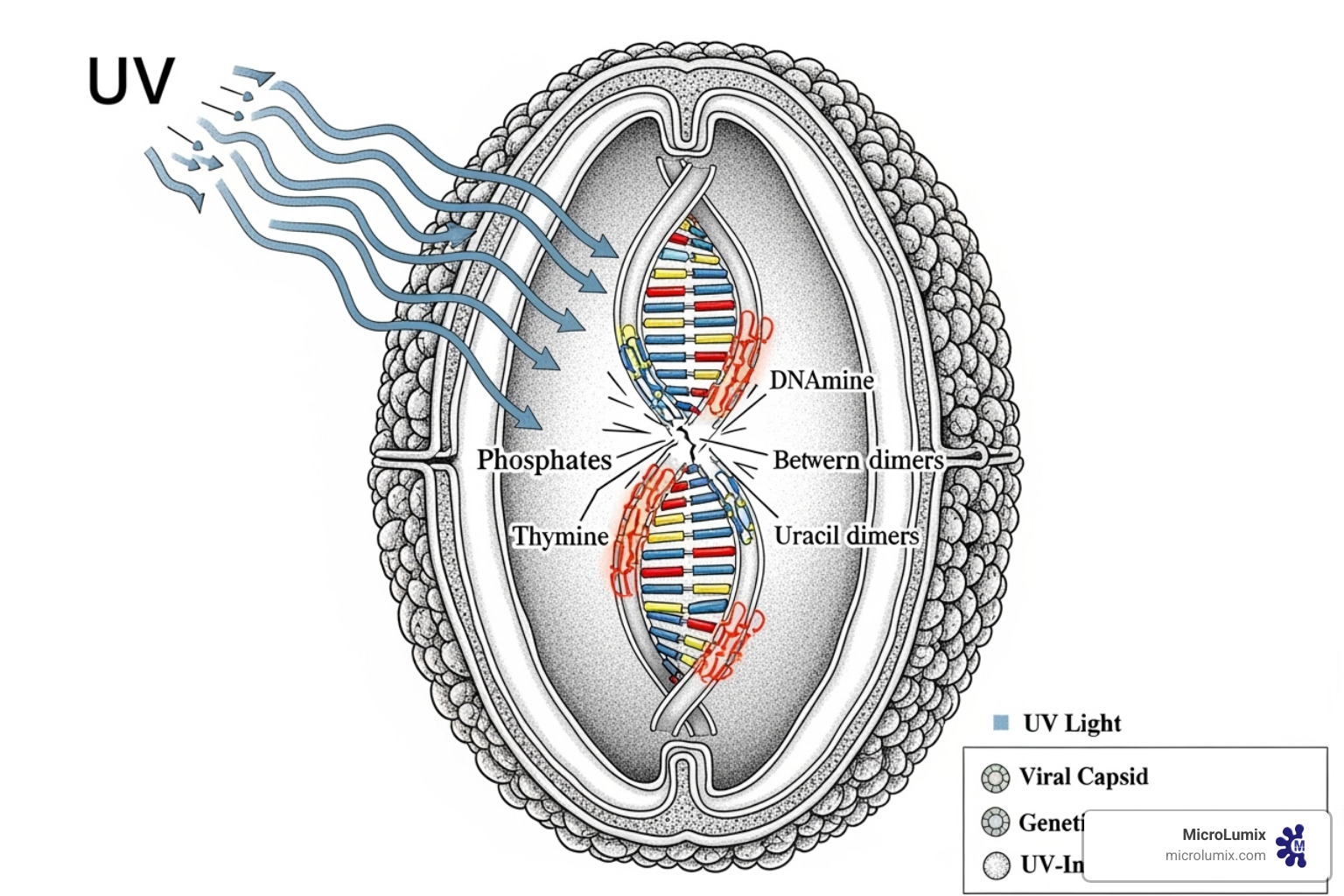
When UVC photons hit pathogens, their DNA and RNA absorb the light. This creates defects called thymine dimers, which damage the microorganism’s genetic instructions. Once these dimers form, the pathogen cannot replicate or repair itself, rendering it harmless. It’s like scrambling an enemy’s communication system; without instructions, they can’t operate.
This germicidal mechanism works against a range of threats, including viruses like SARS-CoV-2, antibiotic-resistant bacteria, fungi, and resilient spores. This broad-spectrum efficacy provides comprehensive protection. This process is remarkably fast. Pathogens can be inactivated in seconds to minutes, offering much faster results than traditional chemical disinfection.
How UVC Disinfects Air vs. Surfaces
While UVC’s germ-killing action is consistent, its application differs for airborne pathogens versus surface contaminants.
For air cleaning, upper-room UVGI systems are popular. Mounted high on walls, they shine UVC light across the upper room. As air circulates, airborne germs are neutralized by this invisible disinfection zone.
HVAC integration goes further by installing UVC systems in air ducts. As air moves through the ventilation system, UVC lamps eliminate pathogens before the air reaches occupied spaces. Research shows these systems can significantly reduce viable coronavirus concentrations in the air.
Surface disinfection relies on the line-of-sight principle. UVC light travels in straight lines, so it only disinfects surfaces it directly illuminates. Any shadowed area remains untreated. This is why direct surface irradiation often requires moving UVC devices like mobile towers to different positions to ensure light reaches as many surfaces as possible.
This limitation also highlights the importance of pre-cleaning. Dirt and debris can create tiny shadows, shielding germs from the UVC light.
Scientific research on UVGI for air disinfection provides detailed information about how these systems perform in real-world settings.
Key Advantages of UVC Decontamination Systems
UVC decontamination systems are game-changers in infection control, with benefits extending beyond effective germ-killing.
Rapid disinfection is a key advantage. While chemical disinfectants may need 10-15 minutes of contact time, UVC can achieve the same results in minutes. A standard hospital room can be disinfected in about 15 minutes, a huge time-saver in busy environments.
Being chemical-free eliminates many problems. It means no toxic fumes, skin irritation, or respiratory issues for staff. There are no harmful residues to affect sensitive equipment or people with chemical sensitivities, and no concerns about chemical storage or disposal.
Reduced manual labor is a major win. Automated UVC systems require minimal intervention, freeing up staff. This automation potential ensures consistency, unlike manual cleaning which can be variable. UVC delivers reliable performance every time.
From an environmental standpoint, UVC creates minimal waste. No empty chemical containers, contaminated cleaning cloths, or environmental impact from harsh chemicals. The lamps are the only component that eventually needs replacing.
More info about automated disinfection
A Guide to UVC Decontamination Systems and Their Applications

UVC decontamination systems are incredibly versatile, like a Swiss Army knife for infection control. There’s a UVC solution for nearly any situation.
Mobile UVC towers are the workhorses of UVC. These wheeled units deliver powerful, flexible disinfection from room to room. With high-powered lamps, remote controls, and “Intelligent Dosing” algorithms, they can be used in diverse settings like patient rooms and cafeterias.
Wall-mounted units offer a “set it and forget it” approach. These permanent fixtures provide consistent, scheduled disinfection, ideal for spaces like operating theaters. A single unit can treat a standard room in just 15 minutes.
UVC chambers are game-changers for smaller, high-touch items like phones and keyboards. These self-sealing units provide contained, high-intensity treatment. Our GermPass system, for example, sanitizes items up to laptop size in under a minute, effectively killing even tough C-Diff endospores.
The adaptability of UVC decontamination systems is a key strength. UVC Decontamination Pods handle larger items like wheelchairs, while HVAC-integrated systems purify air throughout a building. There are even high-powered systems for large area decontamination. This technology scales to protect a single workstation or an entire hospital complex.
Applications in Healthcare and Pharmaceutical Compounding
Healthcare is where UVC decontamination systems are most needed. Hospital-Associated Infections (HAIs) affect one in thirty-one patients, causing over one million cases and nearly 100,000 deaths annually, costing over $28 billion. The COVID-19 pandemic worsened this, with HAIs increasing up to 60 percent.
Environmental contamination is a major factor in spreading these infections. Traditional manual cleaning misses up to 60% of surfaces, which is where UVC becomes a powerful ally.
In hospital rooms and operating theaters, mobile UVC units deliver hospital-grade disinfection, achieving up to 99.999% reduction of microorganisms. This is lifesaving, breaking the chain of infection by allowing for quick and confident room turnover.
Pharmaceutical cleanrooms have unique challenges, as even minor contamination can compromise medications. UVC provides rapid, chemical-free disinfection, which is crucial where chemical residues are unacceptable. It helps meet strict U.S. Pharmacopeia (USP) <797> standards by providing an operator-independent cleaning solution.
During the pandemic, PPE decontamination became a critical application. The CDC recommends UVC for recycling N95 masks, a capability that helped save lives when PPE was scarce.
Evaluation of UVC in hospital pharmacies
Uses Beyond Healthcare
While healthcare is our focus at MicroLumix, UVC decontamination systems are changing cleanliness standards across many industries. UVC’s germicidal power is useful wherever reliable, chemical-free disinfection is needed.
The food and beverage industry was an early adopter of UVC. It’s used for food packaging sterilization, ensuring products are free from contaminants without using chemicals that could alter taste. This is vital for sensitive foods.
Hospitality has acceptd UVC, especially after recent health concerns. Hotels can disinfect guest rooms in minutes, providing peace of mind. UVC systems have become a key selling point for health-conscious travelers.
Public transportation like airlines, buses, and trains use UVC to quickly sanitize high-touch surfaces between passengers, protecting travelers in enclosed spaces.
Office buildings and schools use UVC to reduce absenteeism by limiting the spread of illness. Wall-mounted or HVAC-integrated units continuously purify the air, creating healthier environments for workers and students, which means fewer sick days.
One of the oldest and most important applications is water treatment. UVC inactivates waterborne pathogens like Giardia and Cryptosporidium without adding chemicals.
Industries benefiting from UVC include healthcare, education, hospitality, food processing, transportation, commercial spaces, laboratories, and public safety facilities. Each uses UVC to create safer, cleaner environments.
Evaluating Efficacy and Limitations
UVC decontamination system success isn’t just flipping a switch. Effectiveness hinges on UVC dosage, the combination of irradiance (light intensity) and exposure time. Too little of either prevents the desired log reduction (e.g., a 3-log reduction eliminates 99.9% of pathogens).
But here’s where things get tricky. The shadowing effect is UVC’s biggest nemesis. Since UVC light travels in straight lines, anything tucked behind equipment or in crevices stays untouched.
Distance is also a challenge. UVC follows the Inverse Square Law, meaning the farther a surface is from the light source, the weaker the dose. A surface two meters away might need 20 minutes of treatment, but doubling that distance could require 40 minutes or more.
Material degradation is another reality. Prolonged UVC exposure can be tough on certain plastics and polymers, causing discoloration or brittleness over time.
Perhaps most importantly, UVC is a disinfectant, not a cleaner. Pre-cleaning is essential. Dirt, dust, and organic matter can shield microorganisms from UVC rays, making even the most powerful system fall short.

Measuring and Reporting for Reliable Disinfection
Given these variables, timers are unreliable. Sophisticated UVC decontamination systems shine with their measuring and reporting capabilities.
The gold standard involves UVC sensors and radiometers placed throughout the treatment area. These devices measure the actual UVC energy hitting different surfaces, ensuring an adequate dose is delivered.
We’ve always believed that if you can’t measure it, you can’t manage it. That’s why our GermPass system focuses on delivering a precise, measured UVC dose. Advanced systems create comprehensive data logging that tracks every detail of each disinfection cycle.
After each treatment, facilities receive detailed reports showing which areas were treated, the UVC dose delivered, and cycle duration. This validation of disinfection cycles provides verifiable proof that the job was done right, building confidence in infection prevention protocols and ensuring consistent efficacy.
Key Drawbacks and Limitations of UVC Decontamination Technology
While we advocate for UVC, transparency about its limitations is vital. Understanding these challenges helps facilities make informed decisions on how to integrate UVC decontamination systems.
Line-of-sight dependency is the biggest hurdle. UVC cannot bend around corners, leaving shadowed areas untreated. This often means repositioning mobile units, which can stretch treatment times to 45 minutes or more for resistant organisms like C. diff.
Lamp degradation over time adds complexity. UVC lamps lose intensity with use. Without proper monitoring and replacement, systems may appear to be working while delivering insufficient doses.
Material compatibility issues can’t be ignored. Repeated UVC exposure can make certain plastics brittle or cause discoloration.
The initial investment cost can be substantial, though many facilities find the long-term savings in reduced infections and chemical costs justify the expense.
Regulatory note: the EPA doesn’t routinely certify individual UV devices. Facilities must rely on independent lab certifications from reputable manufacturers.
Finally, some microorganisms have repair mechanisms. If they don’t receive a sufficient UVC dose, they can fix their damaged DNA. This is another reason why proper dosing is absolutely critical.
Safety Standards and Future Innovations
With UVC decontamination systems, safety is critical. While effective against pathogens, conventional UVC light (254 nm) can pose serious health risks if handled improperly. It’s a powerful tool that demands careful handling.
Direct exposure to traditional UVC can cause photokeratitis (a painful “sunburn” of the eye’s cornea) and erythema (skin redness). These risks are why most UVC decontamination systems are designed for use only in unoccupied spaces or with strict safety measures.
Modern technology allows us to harness UVC’s power while keeping people safe by creating controlled environments where the technology can work without risk.
Safety Protocols for UVC Decontamination Systems
A safe environment for UVC decontamination systems requires a multi-layered approach combining technology, training, and common sense.
Modern systems feature occupancy sensors that automatically shut off UVC lamps when a person enters the treatment area. Many also include automatic shut-offs and interlocks to prevent accidental activation.
Proper training is essential for all operators, covering not just system operation but also the risks and how to avoid exposure.
When working near an active UVC source, appropriate Personal Protective Equipment (PPE) is crucial, including UVC-blocking eyewear and protective clothing.
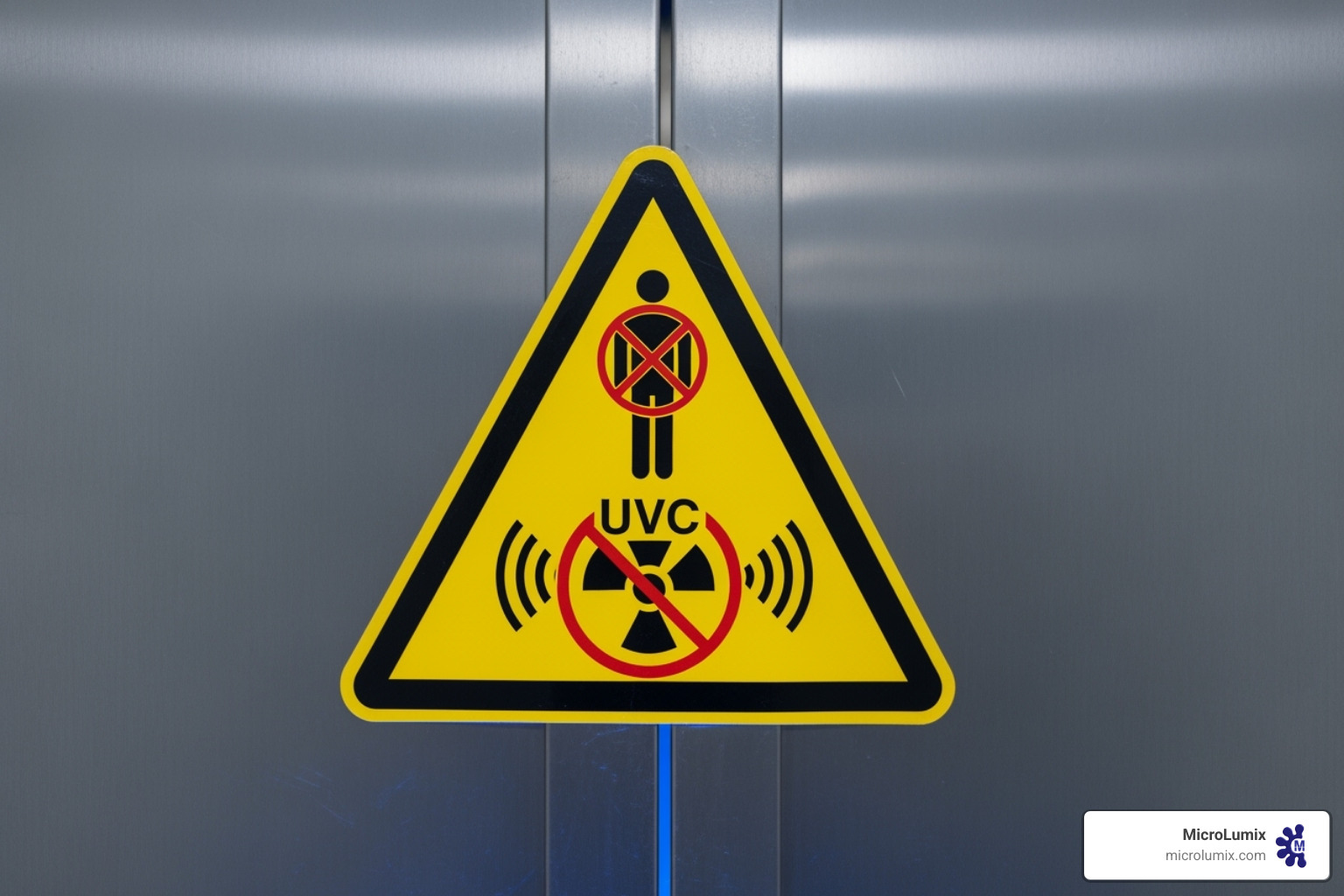
Clear signage is a simple but effective tool to prevent people from accidentally entering treatment areas.
These protocols are guided by international standards like ISO 15858, which sets permissible human exposure limits for UVC. For 254 nm UVC, the limit is 6 mJ/cm² over an 8-hour workday. Newer Far-UVC wavelengths have significantly higher permissible exposure limits, hinting at their improved safety.
The Next Wave: Future Trends in UVC Technology
The world of UVC decontamination systems is evolving rapidly with exciting, game-changing innovations that could revolutionize infection control.
Far-UVC light (222nm) is a significant breakthrough. It can eliminate viruses and bacteria without penetrating the outer layer of human skin or eyes. This means it could potentially be used safely in occupied spaces for continuous disinfection.
Imagine schools, offices, or subways where pathogens are constantly neutralized in real-time. Research shows Far-UVC is both effective against microorganisms and safe for human exposure, opening up new possibilities.
LED-based UVC systems are also changing the landscape. UVC LEDs are more compact, energy-efficient, and have longer lifespans than traditional mercury lamps. They can also be engineered to emit specific UVC wavelengths, allowing for more flexible device design.
This precision leads to increased efficiency and miniaturization. Systems are becoming smaller and more discreet, delivering higher germicidal doses with less power. They can be integrated seamlessly into everyday objects.
Autonomous mobile robots with UVC technology are already navigating facilities and performing disinfection cycles independently. These systems reduce human intervention and ensure consistent coverage in large spaces.
These advances point to a future where infection prevention is proactive, with continuous safeguarding built into our shared spaces.
Research on Far-UVC safety and efficacy
Conclusion
After this deep dive, it’s clear UVC decontamination systems are changing infection control. The science is solid, applications are vast, and the results are proven.
We’ve covered systems that eliminate 99.999% of pathogens in minutes. These chemical-free solutions work everywhere from operating rooms to offices, solving problems manual cleaning can’t.
UVC decontamination systems are not perfect; they require a direct line-of-sight and pre-cleaning. But the technology keeps improving. Far-UVC shows promise for safe use around people, and LED systems are becoming more efficient. We’re just scratching the surface of what’s possible.
The versatility is remarkable. Whether you run a hospital fighting HAIs, a school keeping kids healthy, or a restaurant focused on food safety, there is likely a UVC solution for your needs.
At MicroLumix, we’ve seen how automated disinfection can change the game. Our GermPass system represents the future we believe in—technology that works seamlessly to protect people without disrupting daily routines. When you can sanitize high-touch items immediately after every interaction, you’re preventing contamination before it spreads.
The key takeaway is that UVC decontamination systems are powerful tools that work best within a comprehensive infection control strategy. Success requires proper implementation, maintenance, and understanding their capabilities and limitations.
As we look ahead, we’re optimistic about where this technology is headed. We’re moving toward a world where effective disinfection is automatic, consistent, and built right into our environments.