
Why UVC Disinfection Systems Are Changing Healthcare Safety
UVC disinfection systems use ultraviolet germicidal irradiation to kill bacteria, viruses, and other pathogens by damaging their DNA and RNA structure. These systems offer three main applications:
- Air disinfection – Continuously treat air in occupied spaces or HVAC systems
- Water purification – Remove pathogens without chemicals or harmful byproducts
- Surface disinfection – Rapidly sterilize rooms, equipment, and high-touch areas
UVC technology surged in popularity after the COVID-19 outbreak, as healthcare facilities sought automated solutions to reduce hospital-acquired infections (HAIs). The technology works by targeting nucleic acids and disrupting DNA at the cellular level, leaving microorganisms unable to perform vital cellular functions.
Key benefits include:
- 5-10 minute disinfection cycles for average rooms
- No chemical residues or harmful byproducts
- Effective against chlorine-resistant pathogens like cryptosporidium
- Automated operation reduces labor costs
However, UVC systems have important limitations. They require line-of-sight to be effective, can cause material degradation with prolonged exposure, and pose safety risks to human skin and eyes during operation.
As Debra Vanderhoff, Founder and COO of MicroLumix Bioscience Technology, I’ve spent over 20 years developing automated disinfection systems that address the critical gaps in traditional cleaning protocols. My experience building UVC disinfection systems for healthcare has shown me both their tremendous potential and the important considerations for implementation.
How UVC Disinfection Works: The Science of Germicidal Light
The history of UVC disinfection systems dates to 1877, when scientists first observed that ultraviolet light could kill germs. By 1903, Niels Finsen won a Nobel Prize for using UV light to treat tuberculosis, showcasing its early medical potential.
Understanding how UVC disinfection systems work starts with understanding light itself. UV-C light operates in a specific wavelength range between 100-280 nanometers (nm). This light is invisible to our eyes and has a much shorter wavelength than visible light.
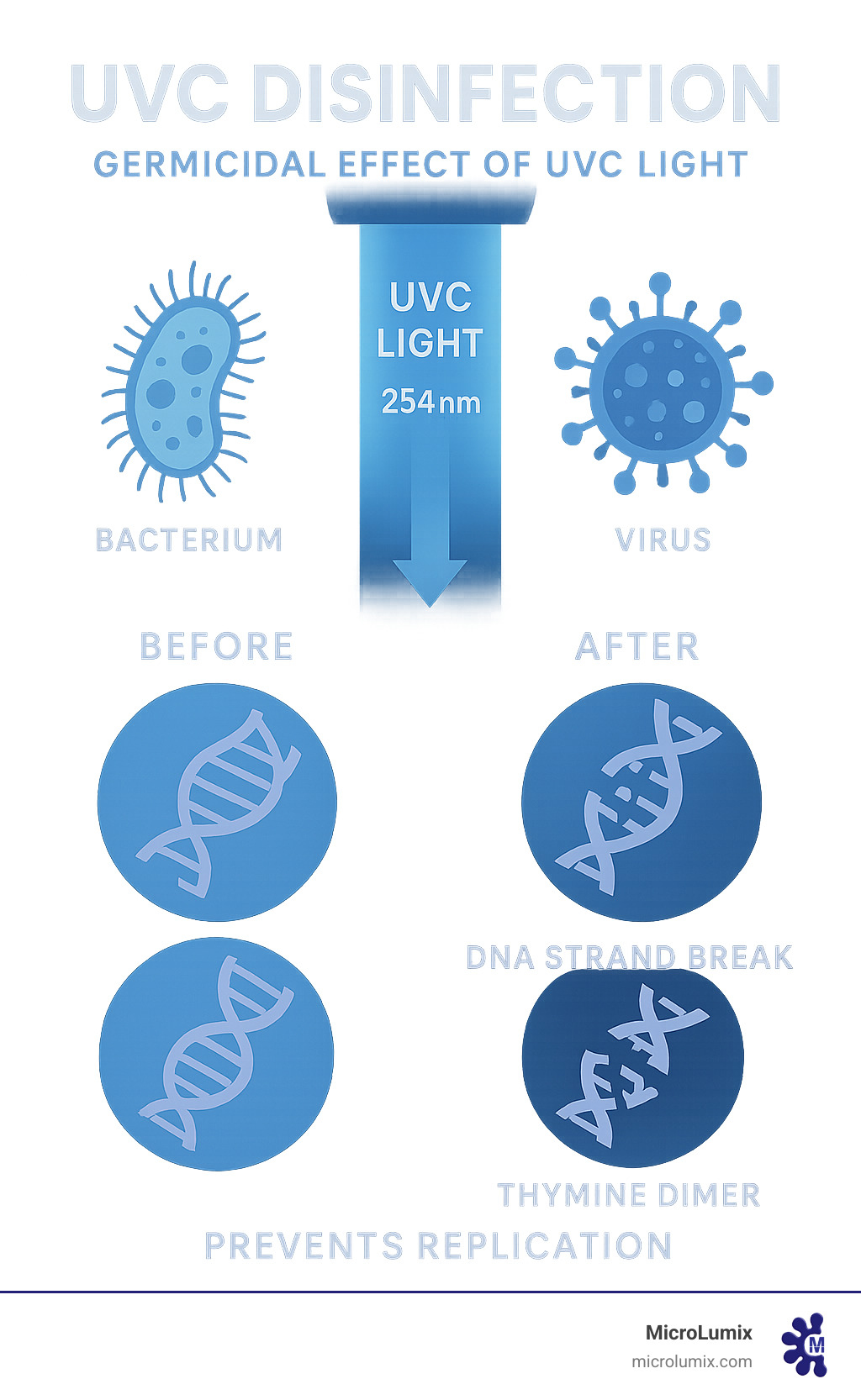
What makes UV-C light so powerful against germs is that it targets the very essence of life: DNA and RNA. When UV-C light hits a microorganism—like a bacterium, virus, or fungus—a fascinating molecular process occurs.
The nucleic acids inside these microorganisms absorb the UV energy. This absorption disrupts the molecular bonds and creates what scientists call thymine dimers in DNA or uracil dimers in RNA. These dimers prevent the microorganism from replicating, metabolizing, or performing any vital cellular functions. The pathogen becomes completely inactivated and can no longer cause infection or reproduce. It’s still there, but it’s essentially been rendered harmless.
The scientific community strongly supports this approach. Organizations like the US EPA and World Health Organization recognize ultraviolet germicidal irradiation (UVGI) as a highly effective method for reducing harmful pathogens. For an accessible overview, see Ultraviolet germicidal irradiation and the US EPA page on UV lights and lamps.
The peak effectiveness for germicidal action occurs around 260-265 nm, which is exactly where DNA and RNA absorb UV energy most readily. This is why this specific wavelength range is so incredibly effective at inactivating microorganisms.
Key Components of Modern UVC Disinfection Systems
Modern UVC disinfection systems are sophisticated technologies that have evolved far beyond early experimental setups, containing several key components that work together for precise germicidal irradiation.
The light source is the heart of any UVC system. For decades, low-pressure mercury-vapor lamps have been the workhorses of the industry, emitting most of their light at 254 nm. These lamps are effective but have drawbacks, including warm-up time and mercury content, which raises environmental concerns.
Fortunately, newer technologies are rapidly changing the landscape. UVC LEDs are becoming increasingly popular because they don’t require warm-up time, are mercury-free, and manufacturers can customize their emission peaks between 255 and 275 nm. Their compact size and durability offer significant advantages, though their output can decrease with increasing temperature.
Excimer lamps, particularly KrCl excimer lamps, represent an exciting frontier. These emit light at 222 nm, a wavelength known as “far UV-C.” This technology has lower penetration depth into human tissue, potentially allowing for disinfection in occupied spaces with reduced human exposure risk.
Ballasts are electrical regulators that ensure lamps operate at optimal power, extending their lifespan and providing consistent, energy-efficient performance.
Modern systems also feature advanced control systems that manage everything from operation cycles to safety protocols. These can range from simple timers to complex software interfaces that provide real-time monitoring and reporting capabilities.
Sensors make these systems both effective and safe. Motion sensors immediately shut off the device if people enter the disinfection area. UV dose sensors measure the actual germicidal energy delivered, while transmittance sensors monitor conditions like water clarity in water treatment applications.
Critical Parameters for Efficacy
The effectiveness of UVC disinfection systems depends on several critical parameters that must be carefully controlled for optimal results. Getting these wrong can render disinfection efforts ineffective.
UVC dose is the most crucial factor. It is the total UV energy delivered to a microorganism, calculated as intensity (mW/cm²) multiplied by exposure time (seconds). Higher doses lead to greater inactivation rates.
Wavelength selection is critical, with the 260-265 nm range providing maximum DNA and RNA absorption. Exposure time directly impacts the dose received—some systems can disinfect an average-sized patient room in 5 to 10 minutes, while others boast disinfection cycles as short as 2 minutes.
Distance and shadowing are significant challenges. UVC light requires a direct line-of-sight to be effective. Areas in shadow will not be sanitized. This is particularly challenging in complex environments like hospital rooms.
The Inverse Square Law is a key physics principle impacting UVC effectiveness. Light intensity decreases rapidly with distance; doubling the distance reduces intensity to one-fourth. Surfaces farther from the lamp require longer exposure times to receive an effective dose.
Temperature and humidity also affect performance. Mercury-vapor lamps achieve optimum efficiency around 20-21°C, while UVC LED output decreases with increasing temperature. Relative humidity changes can affect UV irradiance, with studies showing up to 34% variation when humidity increases from 50% to 90%.
Exploring the Types of UVC Disinfection Systems and Their Applications

The versatility of UVC light means that UVC disinfection systems are not confined to a single application. We see them deployed across a broad spectrum of environments, from ensuring clean drinking water to sterilizing hospital operating rooms. This adaptability makes UVC a powerful tool in our ongoing efforts to create healthier, safer spaces.
Air Disinfection Systems
We breathe air constantly, making airborne pathogens a significant concern, especially in crowded or enclosed spaces. UVC disinfection systems offer effective solutions for air purification:
- Upper-Room UVGI: This method uses UVC fixtures mounted high on walls, directing the UV light across the upper part of a room. As air circulates, pathogens are inactivated in the upper zone, allowing for continuous disinfection in occupied spaces without direct human exposure to the UVC light.
- In-Duct Air Disinfection: UVC lamps can be installed within HVAC (heating, ventilation, and air conditioning) systems. As air is circulated through the ducts, it passes over the UVC lamps, inactivating airborne microorganisms before they are distributed throughout a building. This is a highly effective way to improve indoor air quality for an entire building.
- Standalone Air Purifiers: Many portable air purifiers now incorporate UVC lamps to improve their filtration capabilities, providing an additional layer of protection against airborne viruses, bacteria, and fungi. UVC LED irradiation can effectively inactivate aerosolized viruses, bacteria, and fungi in chamber-type air disinfection systems.
These systems offer continuous disinfection, limiting airborne viral transmission by inactivating viruses shortly after their production, contributing to healthier indoor environments.
Water Purification Systems
Ensuring access to clean, safe drinking water is paramount, and UVC disinfection systems excel in this application without the drawbacks of chemical treatments. UV water disinfection has been gaining popularity since the 1950s.
- Point-of-Use (POU) and Point-of-Entry (POE) Systems: For residential use, POU systems treat water at a single tap (e.g., a kitchen sink), while POE systems treat all water entering the home. For example, some systems can sterilize water from harmful microorganisms, bacteria, mold, and viruses, providing peace of mind about water safety.
- Commercial and Institutional Treatment: From small cottages to large homes, and even commercial potable water applications, UVC systems are widely used. Commercial UVC systems, for example, can inactivate 99.9999% (6-log) of Legionella, even in challenging conditions like low UV transmission (UVT) or high hardness.
- Benefits:
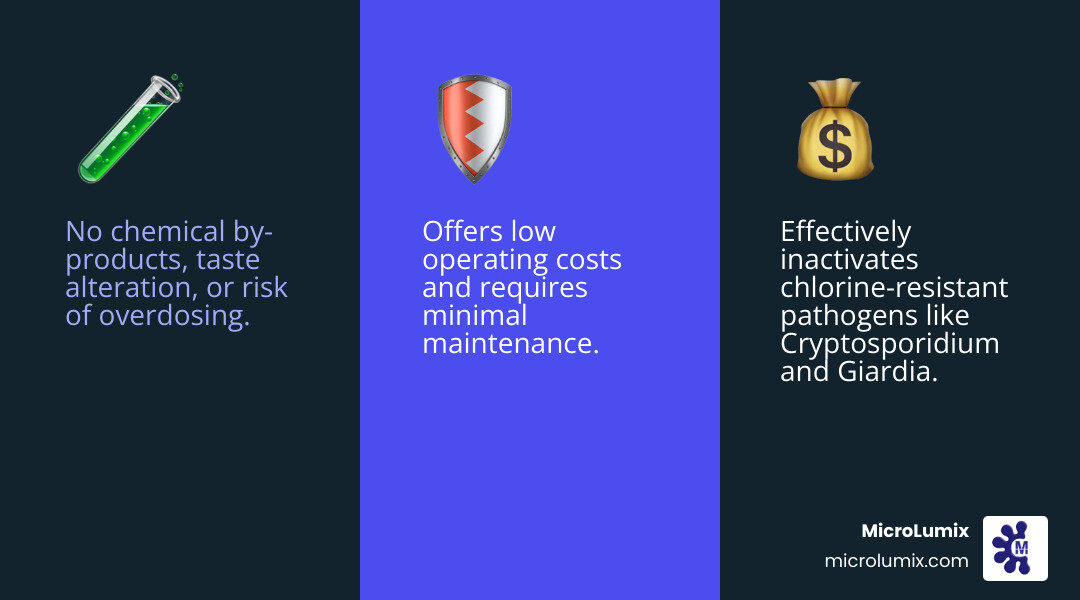
- No Overdose or By-products: Unlike chemical disinfection (e.g., chlorine), UV water disinfection can never overdose, has no effect on taste and odor, and crucially, no carcinogenic disinfection by-products are produced. This is a huge advantage for health and sensory experience.
- Effective Against Resistant Pathogens: UVC water disinfection is considered highly effective against Cryptosporidium and Giardia, pathogens which are almost completely resistant to chlorine.
- Low Operating Costs: Many residential UV water disinfection systems have low operating costs and require no tools for maintenance or lamp replacement, making them an economical choice.
Surface Disinfection Systems
Surfaces are notorious reservoirs for pathogens, especially in high-traffic environments. UVC disinfection systems provide powerful tools for surface sterilization:
- Mobile UVC Robots: These autonomous or semi-autonomous devices move through a space, emitting UVC light to disinfect surfaces. They are particularly useful in large areas or for terminal cleaning in healthcare settings. For example, some mobile room sanitizers can disinfect an average-sized patient room in 5 to 10 minutes.
- Fixed-Mount Systems: UVC fixtures can be permanently installed in rooms, often in operating rooms or patient bathrooms, for rapid disinfection cycles. Some can disinfect rooms in as little as 2 minutes.
- Handheld Devices and Disinfection Chambers: Smaller, portable UVC devices are available for disinfecting high-touch, shared surfaces on the go. Disinfection chambers are used for smaller items, like medical instruments or personal belongings.
- Healthcare-Associated Infections (HAIs): Surface disinfection is critical for combating HAIs. These infections affect millions and cost the healthcare system billions annually. Since environmental contamination is a key factor in HAI transmission, effective cleaning is fundamental. However, studies show manual cleaning often misses surfaces. UVC disinfection serves as an excellent adjunct, with some studies showing it can eliminate 97.7 percent of pathogens in operating rooms.
- Automated Touchpoint Disinfection: This is where our focus lies at MicroLumix. We’ve recognized that high-volume touchpoints are often the culprits in spreading pathogens. Our GermPass system leverages self-sealing UVC chambers to sanitize these critical touchpoints immediately after every touch, achieving an incredible 99.999% efficacy against pathogens. This represents a significant leap forward in targeted, precise disinfection.
Evaluating UVC Technology: Advantages, Disadvantages, and Safety
When you’re making decisions about disinfection methods, especially in healthcare, have all the facts. Let’s take a balanced look at UVC disinfection systems to help you make an informed choice.
| Feature | UVC Disinfection | Traditional Chemical Disinfection |
|---|---|---|
| Speed | Rapid cycles (minutes for rooms, seconds for objects) | Varies greatly; requires wet contact time, manual application |
| Chemical Residue | None | Can leave residues, requires rinsing in some cases |
| Labor | Reduced; automated systems minimize human intervention | Highly labor-intensive, prone to human error |
| Effectiveness | Highly effective against broad spectrum of pathogens | Effective, but efficacy can vary with concentration, contact time, application |
| Limitations | Line-of-sight, material degradation, safety during use | Toxic fumes, corrosive to surfaces, requires PPE, environmental impact |
Advantages and Cost-Effectiveness
UVC disinfection systems have gained traction for compelling reasons, especially in high-stakes environments where traditional methods fall short.
Speed is perhaps the most immediate advantage. When a patient room or operating theater needs to be turned over quickly, waiting for chemical disinfectants is impractical. UVC systems complete cycles in minutes, not hours, improving operational efficiency by getting spaces back into service faster.
The chemical-free nature of UVC eliminates many common issues. There are no harsh odors, chemical residues, or ventilation concerns. Environmental services teams don’t need the same level of protective equipment or to worry about mixing chemicals.
Automation potential is a key advantage for long-term cost savings. Automated systems run consistently, removing the variability and error associated with manual application. The system delivers thorough disinfection every time.
From a pathogen-fighting perspective, UVC light doesn’t discriminate. It’s effective against bacteria, viruses, molds, and fungi—the full spectrum of microorganisms that cause infections. Systems like our GermPass technology achieve 99.999% efficacy against pathogens, providing reliable protection for your infection control protocols.
Limitations and Safety Considerations
Now, let’s talk about the challenges, because understanding these limitations is crucial for successful implementation of UVC disinfection systems.

The line-of-sight limitation is the biggest practical challenge. UVC light only disinfects what it directly illuminates. Areas in shadow remain untreated. This may require repositioning mobile units or using supplemental cleaning methods.
Material compatibility is another consideration. Some plastics and polymers can degrade with repeated UVC exposure. If you have expensive medical equipment with plastic components, you’ll need to weigh the benefits of UVC against potential equipment degradation over time.
Photoreactivation is a phenomenon where some microorganisms can repair UVC-induced DNA damage when later exposed to visible light. This may require higher UVC doses or specific protocols to ensure complete inactivation.
Human safety is non-negotiable. UVC light is harmful to human skin and eyes, causing painful burns and serious injury. Proper UVC disinfection systems must include robust safety features, like motion sensors that shut off the device if a person enters the area.
Some UVC lamps can generate ozone, particularly those emitting wavelengths below 240 nm. Ozone is a powerful disinfectant, but it’s harmful to breathe and can worsen respiratory conditions. Quality systems use specialized glass to filter out these ozone-producing wavelengths.
Standards, Regulations, and Emerging Trends
The UVC industry is still establishing comprehensive standards, so choosing systems and suppliers requires care.
Standardization challenges have historically made it difficult to compare different UVC systems. Some manufacturers have used chemical disinfectant standards that don’t account for UVC-specific factors like photoreactivation or shadowing. Fortunately, organizations like ASTM International are developing UVC-specific standards, and Europe has introduced BS 8628:2022 specifically for automated ultraviolet disinfection.
Regulatory oversight is limited. The EPA does not routinely assess UV device effectiveness, so customers must rely on independent lab certifications and choose reputable manufacturers who can demonstrate efficacy through proper testing.
The future holds exciting developments. Far-UVC technology at 222 nm shows promise for continuous disinfection in occupied spaces because it has limited penetration into human tissue. Research is ongoing, but it could revolutionize environmental disinfection.
Smart systems with dose reporting are becoming the gold standard. Modern systems can monitor and report exactly how much UVC energy was delivered, ensuring verifiable results. This accountability is crucial for regulatory compliance and gives you confidence that disinfection occurred.
The trend toward automated touchpoint disinfection represents the future of targeted infection control. Rather than treating entire rooms, systems like our GermPass focus on the specific high-risk areas where pathogens are most likely to transfer. This precision approach maximizes protection while minimizing limitations.
Frequently Asked Questions about UVC Disinfection
Over two decades in the disinfection industry, I’ve heard many questions about UVC disinfection systems. Here are answers to the most common ones, as it’s natural to have concerns when considering new health and safety technology.
How effective is UVC light against viruses like SARS-CoV-2?
This is a common question, and the answer is yes. UVC light is highly effective at inactivating a wide range of pathogens, including coronaviruses like SARS-CoV-2.
The science behind this effectiveness is well-established. Research shows that UVC disinfection systems can achieve significant viral reduction on surfaces and in the air when properly designed and operated. The required dose for coronavirus inactivation is well-documented.
Coronaviruses are quite susceptible to UVC light, meaning doses effective against more resistant organisms will also inactivate them. However, the effectiveness depends on using a properly designed system, as not all UVC devices are created equal.
Can I use a UVC wand to disinfect my groceries or skin?
The answer is a firm no. Health authorities like the FDA and EPA strongly advise against using UVC wands on skin for several important reasons.
First, direct exposure to UVC radiation can cause serious skin burns and eye injuries. The damage is similar to a severe sunburn but occurs much faster.
Second, their effectiveness is questionable. Key factors like dose, distance, and exposure time are difficult to control with a handheld device, making it hard to ensure proper disinfection without training.
For groceries specifically, washing with soap and water or using EPA-approved disinfectants remains the safer and more reliable approach. Save UVC technology for professional applications where proper safety protocols can be followed.
Is UVC disinfection a replacement for manual cleaning?
This is an important distinction. UVC disinfection is a powerful supplement to, not a replacement for, traditional cleaning protocols. It adds a high-tech layer to an existing routine.
Manual cleaning is essential because surfaces must first be cleared of dust, soil, and organic matter. These contaminants can block UVC light, shielding microorganisms from its germicidal effects.
The most successful disinfection programs combine both approaches. Manual cleaning removes visible soil and debris, while UVC disinfection systems provide an extra level of pathogen inactivation that gives everyone peace of mind. This layered approach is particularly important in healthcare settings.
At MicroLumix, we’ve designed our GermPass system to work seamlessly with existing cleaning protocols. It handles those critical touchpoints that get contaminated immediately after manual cleaning, providing continuous protection. But we never position it as a replacement for good old-fashioned cleaning—rather, it’s the high-tech partner that makes your cleaning program even more effective.
Conclusion: The Future of Disinfection is Automated and Precise
UVC disinfection systems represent a leap forward in creating safer environments. The science is clear: they offer powerful, chemical-free disinfection against a range of pathogens in minutes.
This technology addresses key challenges in healthcare. Traditional manual cleaning leaves gaps, leading to hospital-acquired infections that affect millions and cost billions. UVC disinfection systems supplement cleaning practices by providing a crucial extra layer of protection.
The rapid disinfection cycles mean we can turn rooms around faster without compromising safety. The automation potential reduces the burden on already stretched healthcare staff. And the broad-spectrum effectiveness gives us confidence that we’re truly making spaces safer for everyone.
Of course, we must always remember that proper application is everything. Understanding limitations—like shadowing effects and material compatibility—ensures we deploy these systems responsibly and effectively. Safety considerations aren’t just important; they’re absolutely critical when working with UV technology.
The most promising aspect is that the future is automated. We are moving from manual processes toward validated, targeted disinfection that can be measured and verified. This represents a shift from reactive cleaning to proactive, continuous protection.
At MicroLumix, we’ve acceptd this vision of the future with our GermPass system. It’s the world’s only lab-certified, automatic touchpoint germ-killing system that uses self-sealing UVC chambers to sanitize high-volume touchpoints immediately after every touch. With 99.999% efficacy against pathogens, it represents exactly the kind of precise, automated solution that’s changing healthcare safety.
The days of wondering if a surface is clean are numbered. Automated UVC technology creates measurable, verifiable results, giving healthcare workers and patients the confidence they deserve.
Learn how automated UVC technology is creating safer healthcare environments.