
Why UVC Germicidal Lamps Are Revolutionizing Modern Disinfection
UVC germicidal lamps are specialized ultraviolet light sources that emit radiation at 254 nanometers to destroy harmful microorganisms by disrupting their DNA and RNA. They offer a powerful, chemical-free solution for eliminating pathogens across air, water, and surface applications.
Key Facts About UVC Germicidal Lamps:
- How they work: Emit UVC light at 254 nm wavelength that damages microbial DNA/RNA
- What they kill: Bacteria, viruses, protozoa, mold spores, and fungi
- Main applications: Air purification, water treatment, surface disinfection
- Lamp types: Low-pressure mercury, excimer, and UVC-LED technologies
- Lifespan: Typically 8,000-10,000 hours of operation
- Safety requirement: Must be shielded from direct human exposure
While UVC light’s germicidal properties were finded in the early 20th century, recent advances have made these systems more efficient and accessible. Modern UVC lamps provide up to 99.99% pathogen inactivation without chemicals, residues, or significant maintenance.
For healthcare administrators, UVC technology is a game-changer for continuous disinfection. Unlike manual cleaning, which can be inconsistent, UVC systems provide automated pathogen control for high-touch surfaces and air circulation systems.
As Debra Vanderhoff, Founder and CEO of MicroLumix Bioscience Technology, I’ve spent over 20 years developing innovative disinfection solutions, including advanced automated systems that use UVC germicidal lamps to create safer healthcare environments. My experience has shown me how this technology can dramatically reduce hospital-acquired infections while streamlining operational efficiency.
How UVC Light Delivers Powerful, Chemical-Free Disinfection
UVC germicidal lamps act like an invisible cleaning crew, destroying harmful germs with light. This method avoids harsh chemicals, toxic fumes, and messy residues, delivering pure, effective disinfection at the speed of light.
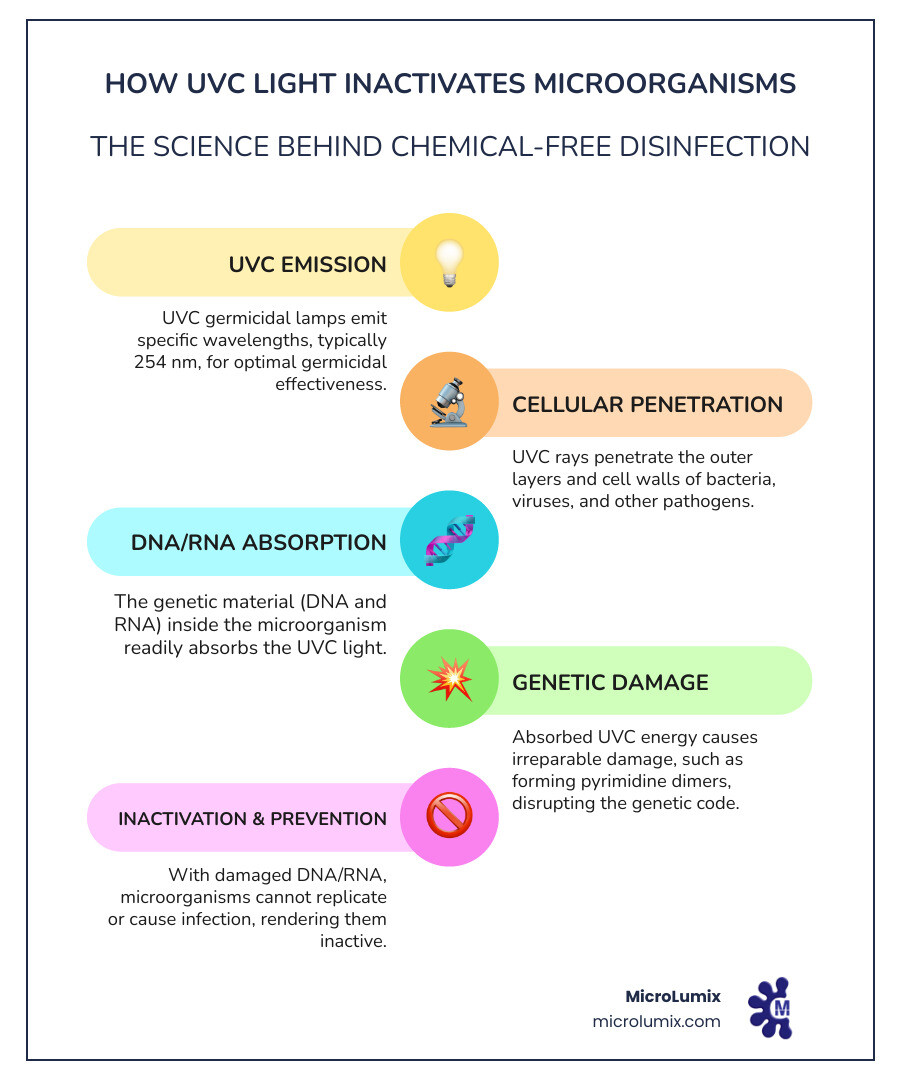
The magic is in the UVC spectrum, a range of ultraviolet light deadly to microorganisms. When UVC light hits bacteria, viruses, or mold spores, it targets their DNA and RNA, acting like a microscopic surgeon.
UVC light creates pyrimidine dimers in the genetic material of these invaders. This process damages the DNA structure, creating molecular “traffic jams” that prevent the microorganism from copying itself.
Without the ability to replicate, these pathogens become harmless. They might still be physically present, but they are essentially broken and unable to cause infection. This is germicidal irradiation at its finest, turning dangerous microorganisms into inactive remnants.
This process is universally effective against stubborn viruses, resilient bacteria, and persistent molds by disrupting their genetic blueprints.
| Feature | UVC Disinfection | Traditional Chemical Cleaning |
|---|---|---|
| Effectiveness | 99.99% pathogen inactivation, broad spectrum | High but depends on proper application |
| Speed | Instant inactivation on contact | Requires dwell time (minutes to hours) |
| Residue | Completely chemical-free, no residues | May leave chemical traces |
| Operational Cost | Very low after installation | Ongoing chemical and labor costs |
The Science Behind Germicidal Inactivation
The optimal wavelength for UVC germicidal lamps is 254 nm. This represents the peak germicidal effectiveness where microorganisms’ DNA and RNA absorb UV energy most efficiently, shattering their genetic code.
When UVC light at this wavelength penetrates a microorganism, it’s absorbed by the nucleic acids, triggering irreparable molecular damage. The DNA and RNA absorption is so thorough that it creates multiple lesions throughout the genetic material.
The result is complete replication prevention. Viruses can’t make copies of themselves, bacteria can’t multiply, and spores can’t grow. The pathogens become harmless microorganisms—present but powerless.
This process is reliable because it targets the basic building blocks of life. Unlike with chemical disinfectants, pathogens cannot develop resistance to having their DNA scrambled by ultraviolet radiation.
UVC vs. Other Disinfection Methods
The advantages of UVC germicidal lamps are clear when compared to traditional chemical disinfectants, which have several drawbacks.
Chemical-free operation means no new substances are introduced into your environment. This eliminates concerns about harmful residues, chemical interactions, or the need for special ventilation.
Low operating costs are a key benefit after the initial investment. While chemical disinfectants require continuous purchasing, UVC systems mainly need electricity and occasional lamp replacement.
Automation potential is where UVC truly excels. Systems can be set to run on schedules, activate with motion sensors, or operate continuously in air handling units, providing a consistency that manual cleaning cannot match.
The main limitation of UVC is its line-of-sight dependency; the light must directly reach the pathogen to work. Shadows and hidden areas won’t be disinfected, making proper system design crucial for effective coverage.
Despite this, UVC germicidal lamps offer a compelling combination of effectiveness, safety, and convenience, representing a fundamental shift toward smarter, more sustainable disinfection.
Key Applications and Benefits Across Industries
The impact of UVC germicidal lamps across industries is remarkable. From the air in office buildings to tap water and hospital surfaces, UVC light works behind the scenes to improve safety. The technology’s versatility provides core benefits like chemical-free operation, exceptional effectiveness, and longevity, with most quality lamps lasting 8,000 to 10,000 hours—a full year of continuous operation.

Air Purification in HVAC and Buildings
Indoor air quality is a major concern, and UVC germicidal lamps installed in HVAC systems are a key solution for healthier indoor environments. As air circulates, it passes UVC lamps that inactivate airborne pathogens like bacteria, viruses, and mold spores.
UVC also cleans HVAC cooling coils, which are prime locations for mold and biofilm growth. Clean coils lead to a double benefit: improved indoor air quality and better energy efficiency, resulting in lower energy bills.
For larger spaces, upper-room germicidal irradiation systems direct UVC light toward the ceiling, creating a disinfection zone where air is cleaned as it circulates. The ASHRAE standards for UVC air disinfection provide detailed implementation guidelines.
Water Sterilization for Homes and Municipalities
UVC germicidal lamps work continuously to keep our water supply safe, from individual homes to entire cities. Homeowners can use point-of-use systems for a single faucet or point-of-entry systems for the whole house, which is especially valuable for well water.
In water treatment, UVC is highly effective against chlorine-resistant pathogens like Cryptosporidium and Giardia. For this reason, many municipal water treatment plants use UVC as an additional safety barrier, a practice supported by EPA guidelines for UV water treatment.
Surface Disinfection in Healthcare and Public Spaces
UVC germicidal lamps excel at surface disinfection. In healthcare, UVC technology is a game-changer in the fight against healthcare-associated infections (HAIs). Unlike manual cleaning, UVC provides consistent results by inactivating pathogens wherever the light reaches.
Hospitals, laboratories, and high-touch public surfaces benefit greatly from UVC. Operating rooms, patient rooms, and common areas can be thoroughly and regularly disinfected.
The real innovation is in automated disinfection systems. At MicroLumix, our GermPass system addresses high-volume touchpoints by using self-sealing UVC chambers to sanitize surfaces immediately after every touch. This provides continuous protection with 99.999% efficacy without disrupting normal activities. This advanced automation represents the future of surface disinfection, providing the reliability that busy healthcare environments demand.
The Science and Types of UVC Germicidal Lamps
Understanding the different types of UVC germicidal lamps helps in choosing the right solution. While all emit pathogen-fighting UVC light, they operate differently, much like various car models are suited for different jobs. This diversity ensures a UVC solution exists for nearly any situation, from a small office to an entire hospital wing.
Key Considerations for UVC Germicidal Lamps
Several distinct UVC technologies are available, each with unique strengths.
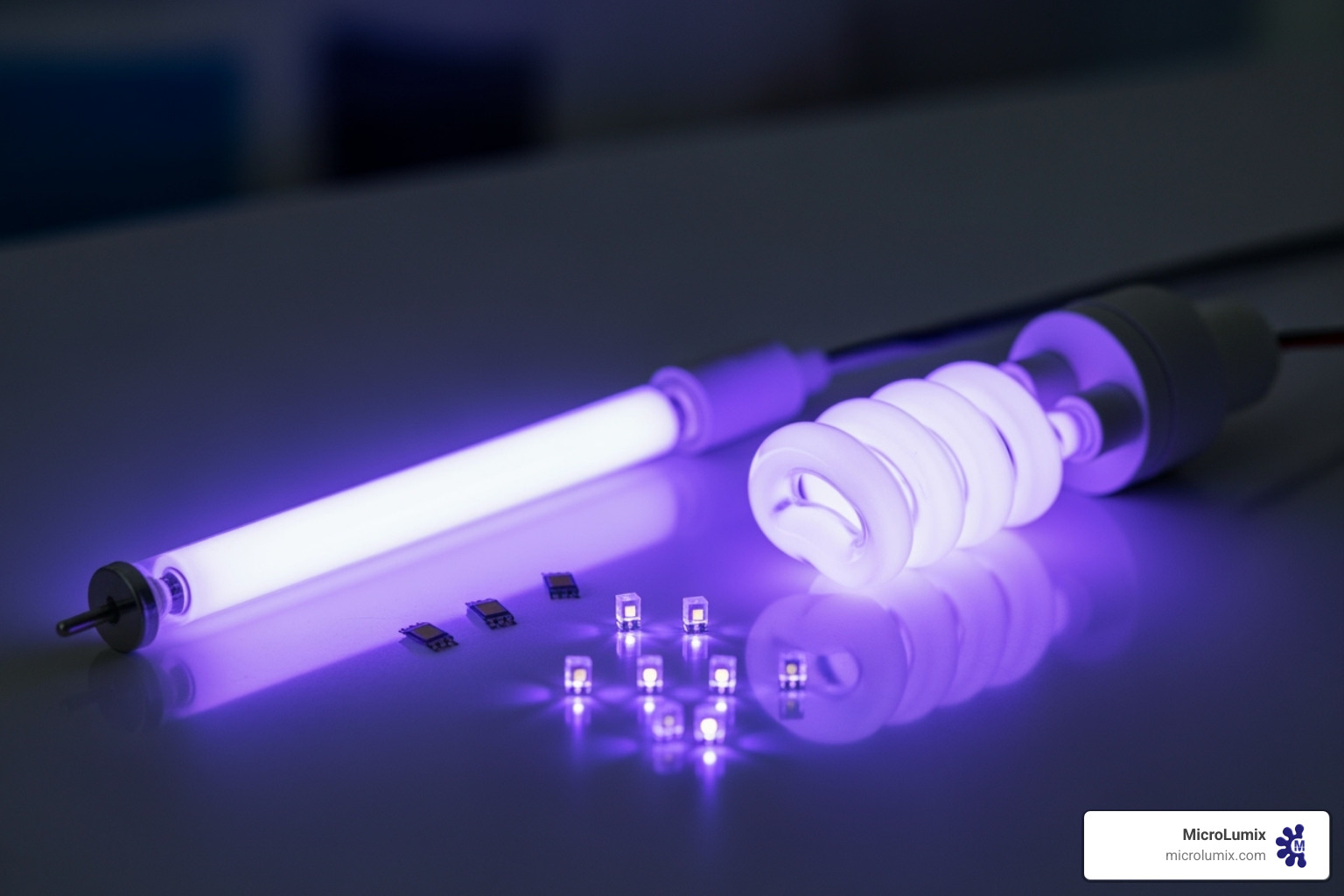
Low-pressure mercury lamps are the workhorses of UVC disinfection. Similar to fluorescent lights but without the phosphor coating, they emit pure UVC light at 253.7 nm. They are highly reliable, lasting over 8,000 hours with consistent UV output.
Amalgam lamps are a more powerful version of mercury lamps. Using a metal amalgam, they handle temperature changes better and produce up to three times more UVC output. This makes them ideal for high-demand applications like large-scale water treatment.
Excimer lamps are a modern, mercury-free approach using noble gases. They reach full power instantly and emit specific wavelengths (e.g., 222 nm), opening possibilities for targeted applications.
UVC-LEDs are semiconductor-based lights revolutionizing the industry. They are versatile, turn on instantly, can be made incredibly small, are durable, and contain no mercury. The market for these is expected to reach nearly $1 billion by 2023.
Wattage options range from a compact 6W lamp for small spaces to powerful 100W systems for entire rooms. Most lamps offer impressive lifespans of 8,000 to 10,000 hours. Available form factors include linear tubes for HVAC systems, compact lamps for tight spaces, and other specialized shapes to maximize UV output.
The Future of Disinfection: Emerging UVC Technologies
The future of UVC technology is exciting. The next generation of germicidal lamps promises to be safer, more versatile, and more integrated into our daily lives.
The star is Far-UVC light, particularly at the 222 nm wavelength. Unlike traditional 254 nm UVC, Far-UVC has a shorter penetration depth, meaning it can inactivate airborne germs while being safely absorbed by the outer layer of human skin and eyes. This allows for continuous disinfection in occupied spaces like hospitals and schools.
Meanwhile, UVC-LED technology continues to improve and become more affordable. Their instant-on capability and mercury-free design make them more efficient and environmentally friendly. The miniaturization and reliability of UVC-LEDs are making pathogen protection more accessible than ever, from pocket-sized sanitizers to advanced automated systems like our GermPass technology.
Essential Safety and Environmental Guidelines
UVC germicidal lamps are powerful tools that require careful handling. While effective, they demand strict safety protocols. The most successful UVC installations prioritize safety from the start, as the UVC light that inactivates pathogens can also damage human cells.
Understanding and Mitigating Exposure Risks
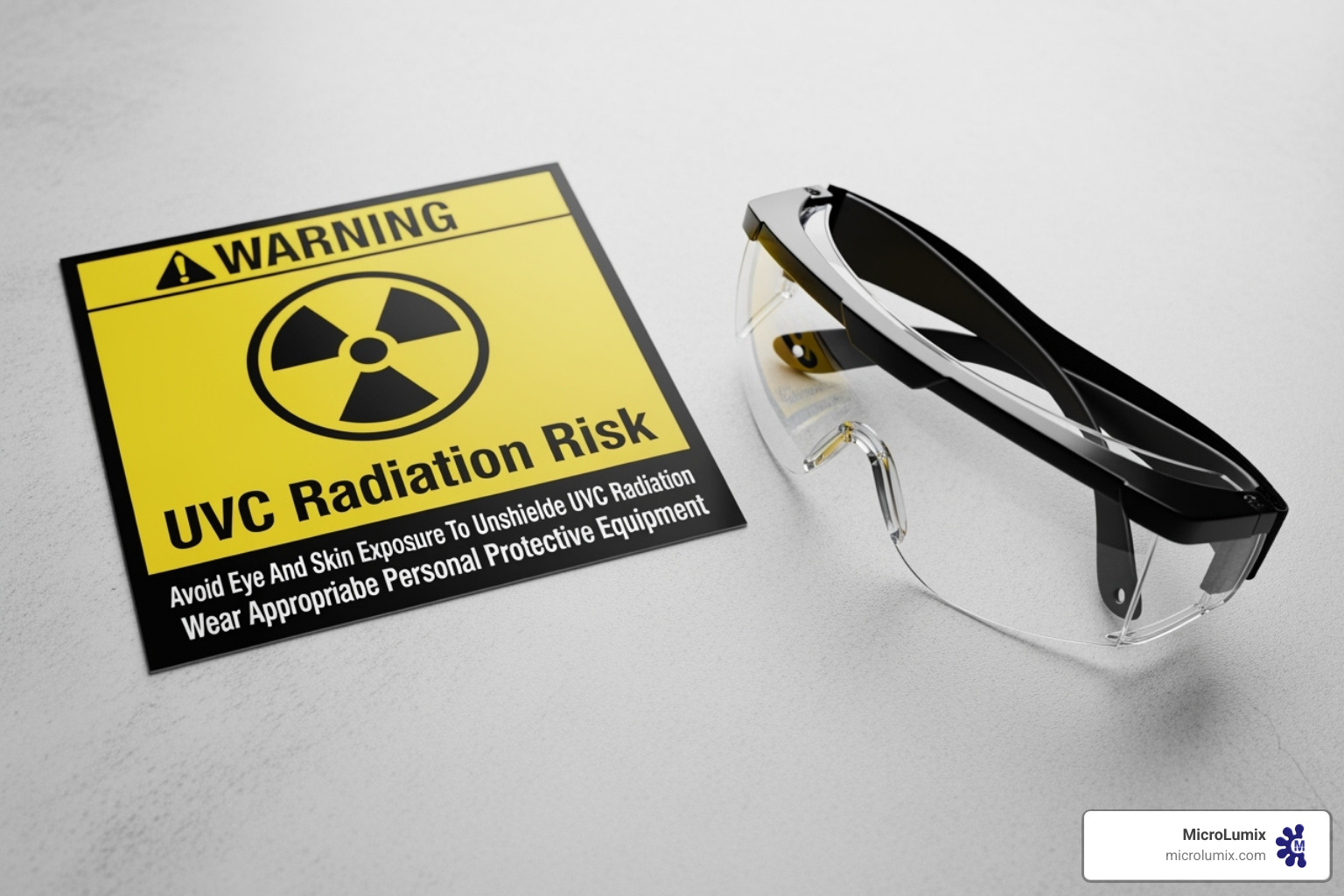
Direct exposure to UVC germicidal lamps can cause painful injuries, such as a skin reaction similar to severe sunburn or photokeratitis in the eyes, which feels like sand in the eyes. These injuries can lead to long-term health issues with repeated exposure.
Preventing exposure is achievable with the right precautions. Protective shielding is the first line of defense, ensuring light never reaches occupied areas. This includes enclosed fixtures and opaque barriers to block direct and reflected rays.
Modern UVC systems incorporate smart safety features like motion sensors that shut down lamps when a person enters a treatment area. Many systems also include audible alarms and start-up delays. Remote controls and timers ensure disinfection only occurs when spaces are unoccupied.
When maintenance is required near operating lamps, proper personal protective equipment is non-negotiable. This includes certified eye protection that blocks UVC, full-coverage clothing, and nitrile gloves.
Environmental Factors for UVC Germicidal Lamps
Responsible UVC use includes considering environmental impact, particularly mercury content and ozone production.
Many traditional UVC germicidal lamps contain small amounts of mercury. While sealed during operation, proper disposal through certified recycling programs is crucial at the lamp’s end-of-life to prevent environmental contamination.
Some UVC lamps emit light at a 185 nm wavelength, which can convert oxygen into ozone, a powerful but potentially harmful gas. Fortunately, ozone-free lamps solve this issue. They use special fused quartz glass that blocks the 185 nm wavelength while allowing the germicidal 254 nm light to pass through. For most applications, ozone-free lamps provide the necessary disinfection power without the added complexity of managing ozone exposure.
Frequently Asked Questions about UVC Lamps
At MicroLumix, we love sharing our knowledge about UVC germicidal lamps. Over the years, I’ve noticed the same questions come up again and again. Let me address the most common ones we hear.
Can you see UVC light?
No, you cannot see UVC light. The human eye only detects the visible spectrum (about 400-700 nanometers). UVC light operates at 254 nanometers, which is invisible.
The distinctive blue or violet glow from many UVC germicidal lamps is not the UVC radiation itself. This visible light is a byproduct of the gases inside the lamp; the germ-killing UVC rays remain invisible. This invisibility is why safety precautions are so crucial—you literally cannot see the danger.
Do UVC lamps kill COVID-19?
This question became incredibly important during the pandemic, and I’m happy to share some encouraging news. Yes, UVC light is highly effective at inactivating the SARS-CoV-2 virus that causes COVID-19. Multiple peer-reviewed studies have confirmed that UVC light can successfully inactivate this virus.
The key word here is “inactivating” rather than “killing.” UVC light works by disrupting the virus’s RNA (its genetic material), preventing it from replicating and causing infection. It’s like scrambling the virus’s instruction manual – without readable instructions, it can’t make copies of itself or hijack your cells.
The effectiveness depends on the UVC dose delivered to the virus. This means several factors come into play: the intensity of the lamp, how long the virus is exposed to the light, and the distance from the light source. The closer and longer the exposure, the more effective the treatment. This principle applies not just to COVID-19, but to many other viruses and pathogens as well.
How often do UVC lamps need to be replaced?
This is probably the most practical question we get, and the answer directly impacts your maintenance planning and budget. Most UVC germicidal lamps have a rated lifespan of 8,000 to 10,000 hours of continuous operation. To put this in perspective, if you’re running your system 24 hours a day, seven days a week, you’re looking at roughly one year before replacement is needed.
Many modern UVC germicidal lamps are designed to maintain relatively constant UV output through most of their rated life. However, here’s the critical part that many people don’t realize: you must replace the lamp even if it still appears to be working. A UVC lamp might continue glowing and looking perfectly normal, but its actual germicidal output gradually decreases over time. It’s like a flashlight with dying batteries – it might still produce some light, but not enough to be truly effective.
A lamp that has exceeded its rated life may no longer provide the necessary germicidal dose to effectively inactivate pathogens. This means you could have a false sense of security, thinking your disinfection system is working when it’s actually operating at reduced capacity. Following the manufacturer’s replacement schedule isn’t just a suggestion – it’s essential for maintaining the system’s effectiveness and protecting the people who depend on it.
Conclusion
UVC germicidal lamps are changing how we approach cleanliness and safety. These lamps work by disrupting the DNA and RNA of pathogens without chemicals, using light to perform heavy-duty disinfection.
What makes UVC technology so compelling is its incredible versatility. Whether it’s cleaning the air in an HVAC system, ensuring tap water is safe, or sanitizing surfaces in hospitals, these lamps adapt to critical hygiene needs. At MicroLumix, we’ve seen this real-world impact through our GermPass system, which automatically sanitizes high-touch surfaces after every use.
The future holds even more promise. Far-UVC technology is opening doors to disinfection in occupied spaces, while UVC-LED advances are making systems smaller, more efficient, and mercury-free. These improvements represent a fundamental shift toward making advanced disinfection common and accessible.
Of course, with powerful technology comes the need for responsible use. UVC light demands respect and proper safety measures. Modern systems are designed with multiple safety features, making them both effective and safe when used correctly. The industry’s move toward ozone-free and mercury-free options also shows a commitment to protecting both people and the planet.
As we look ahead, UVC germicidal lamps are laying the groundwork for a cleaner, healthier tomorrow. The technology continues to evolve, becoming safer and more integrated into our daily lives. At MicroLumix, we’re excited to be part of this journey, developing solutions that make the invisible threat of pathogens a thing of the past.
Ready to see how advanced UVC technology can transform your facility’s hygiene protocols? Explore advanced automated UVC solutions for your facility and find what’s possible when innovation meets real-world needs.