
Why UVC Light Sanitization Matters in Modern Healthcare
UVC light sanitization uses short-wavelength ultraviolet light (200-280 nanometers) to destroy the genetic material of pathogens like bacteria and viruses, rendering them unable to reproduce. This chemical-free method damages microbial DNA and RNA, achieving up to 99.99% pathogen reduction when applied correctly.
Key Facts About UVC Light Sanitization:
- Wavelength: 200-280 nm range, with peak effectiveness around 254-265 nm
- Mechanism: Damages pathogen DNA/RNA to prevent replication
- Effectiveness: Can eliminate 99.99% of bacteria, viruses, and fungi
- Applications: Air purification, surface disinfection, water treatment
- Limitations: Requires direct line-of-sight, affected by distance and shadows
- Safety: Can cause skin and eye damage with direct exposure
The COVID-19 pandemic sparked renewed interest in UVC technology, but this germicidal light has been used in healthcare since the 1930s. Unlike chemical disinfectants, UVC leaves no harmful residues and works in minutes.
However, effectiveness depends on proper dosage—the combination of light intensity and exposure time. Distance is also critical, as UVC follows the inverse square law, where doubling the distance can quadruple the required disinfection time.
As Debra Vanderhoff, Founder and COO of MicroLumix, I’ve spent over four years developing automated UVC light sanitization systems for healthcare. My experience has revealed both the immense potential and the critical safety considerations of this powerful, chemical-free disinfection technology.

The Science of UV Light: From Sunlight to Sanitizer
Ultraviolet (UV) light is an invisible spectrum with three distinct types: UV-A, UV-B, and UV-C.
UV-A light (315-400 nm) makes up 95% of the UV radiation reaching Earth. It’s responsible for tanning but is ineffective for killing germs.
UV-B rays (280-315 nm) cause sunburn but lack the energy for effective sanitization.
UV-C light (200-280 nm) is the key to UVC light sanitization. Earth’s ozone layer absorbs it, so it must be created artificially to be harnessed for its germ-fighting power. The peak germicidal range is 254-265 nm, where the light is readily absorbed by the DNA and RNA of microorganisms. Some UVC lamps, especially those below 240 nm, can produce ozone, which requires careful air quality management. For an accessible overview of germicidal UV, see Ultraviolet germicidal irradiation.
How UVC Light Inactivates Pathogens
When UVC light hits a microorganism, its short wavelengths penetrate the outer cell membrane and are absorbed by the genetic material inside.

This absorbed energy causes the formation of thymine dimers, which cross-links the genetic material. This damage scrambles the pathogen’s genetic code, preventing it from functioning or reproducing. This process doesn’t physically destroy the pathogen but inactivates it, rendering it harmless. This principle applies consistently to viruses, bacteria, and fungi.
Factors Influencing UVC Sanitization Effectiveness
Effective UVC light sanitization depends on several key factors:
- Dose: The most critical factor is the UVC dose, calculated as intensity multiplied by time (mW/cm²). A high intensity for a short time can be as effective as a lower intensity for a longer time.
- Distance: UVC effectiveness decreases with distance, following the inverse square law. Doubling the distance from the source can require four times the exposure time.
- Line-of-Sight: UVC light only sanitizes surfaces it can directly “see.” Any shadows or crevices will remain untreated, often requiring devices to be repositioned for complete coverage.
- Surface Materials: Some plastics and polymers can degrade under prolonged UVC exposure, which is a key consideration for medical equipment.
- Environment: High humidity can reduce UV output, and performance can be affected by temperature. Traditional mercury-vapor lamps work best around 20-21°
C, while UVC LED performance often decreases as temperatures rise. - Pathogen Resistance: Different microorganisms have varying levels of resistance to UVC light, with some requiring a higher dose for inactivation.
Gauging the Germ-Killing Power of UVC Light Sanitization
When properly applied, UVC light sanitization can eliminate up to 99.99% of bacteria, fungi, and viruses. The most effective germicidal wavelength is around 254 nanometers.
Real-world performance is impressive. Studies found that UVC can inactivate the SARS-CoV-2 virus in as little as two to nine minutes. Advanced far-UVC systems can eliminate 99.99% of the virus within one meter in just two minutes.
Even everyday items benefit. UVC phone sanitizers can reduce germs by over 90% in a single 30-second cycle. The technology is also effective against the fungi that cause athlete’s foot and bacteria on toothbrushes.
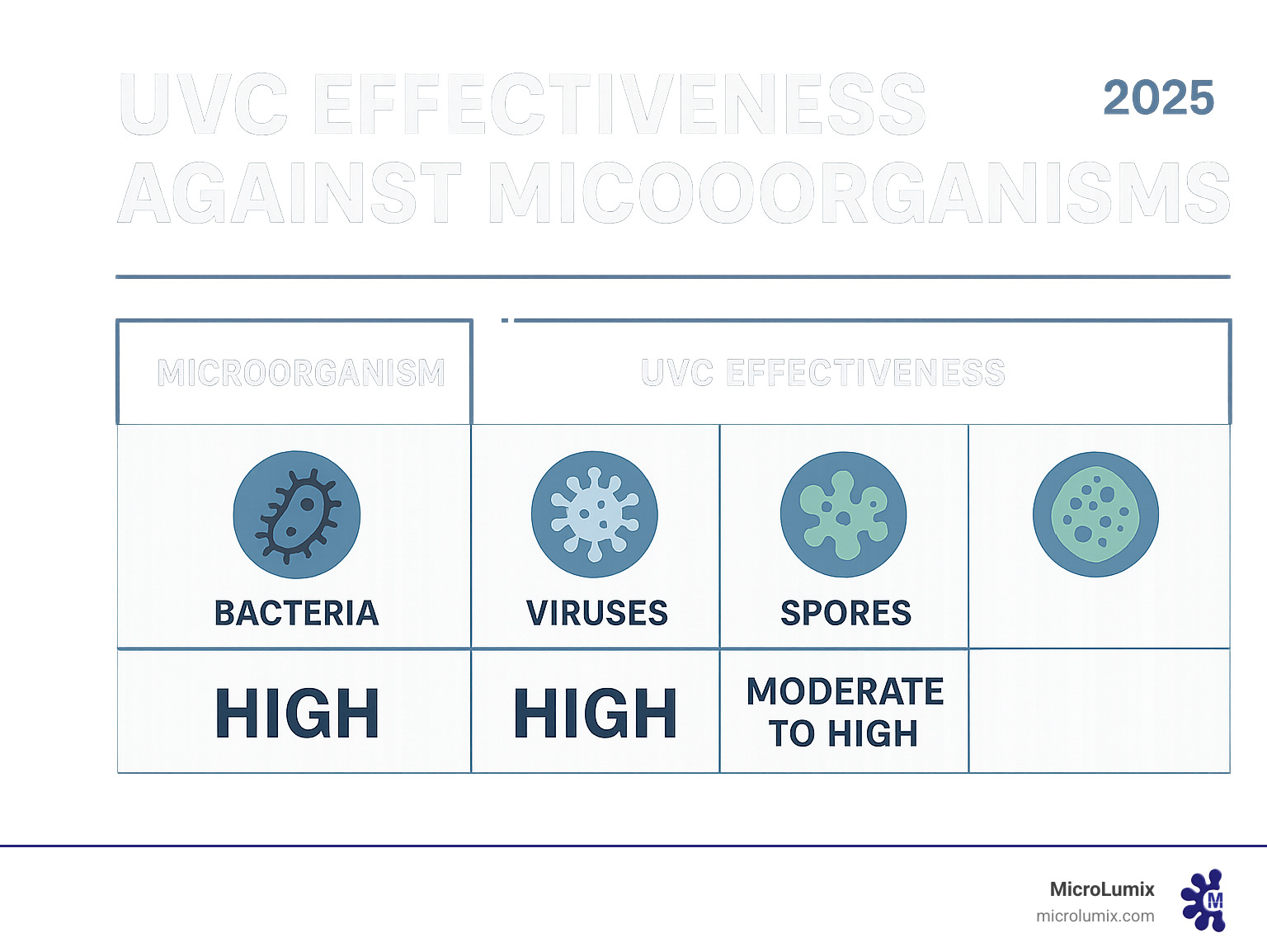
In healthcare, UVC is critical for preventing healthcare-associated infections (HAIs). One major study showed that hospital UVC use cut the transmission of four major superbugs by 30%. However, some pathogens, like certain bacterial spores, are more resistant and require higher UVC doses.
Limitations and Challenges of UVC Disinfection
Despite its effectiveness, UVC light sanitization has limitations:
- Line-of-Sight Dependency: UVC cannot penetrate objects. The shadowing effect means any blocked or hidden surfaces remain unsanitized, often requiring multiple device placements.
- Material Degradation: Prolonged UVC exposure can break down certain plastics and polymers, affecting the appearance and integrity of equipment.
- Dose Measurement: Accurately measuring the UVC dose delivered to a surface is difficult without specialized equipment, making it hard to guarantee efficacy.
- Photoreactivation: Some microorganisms can repair UVC-induced DNA damage when subsequently exposed to visible light. This “dark repair” mechanism can partially reverse the sanitization effect.
- No Residual Effect: Once the UVC light is off, surfaces can be immediately recontaminated. UVC provides no lasting protective barrier like some chemical disinfectants.
These challenges highlight why UVC is best used as part of a comprehensive infection control strategy.
UVC and Traditional Disinfection Methods
Compared to traditional cleaning, UVC light sanitization offers distinct advantages. Manual cleaning is labor-intensive, prone to human error, and requires chemicals to sit for a specific “wet contact time” that is often missed.
UVC is a chemical-free alternative that leaves no harmful residues, a significant benefit in sensitive environments. From an environmental standpoint, UVC LEDs are a cleaner technology than chemical disinfectants. Furthermore, UVC’s automation potential allows for consistent, reliable disinfection with minimal human error, such as in HVAC systems or with mobile robots.
Currently, UVC excels at surface sanitization and low-level disinfection. The CDC generally recommends it for non-critical applications, positioning it as a powerful supplement to, not a replacement for, established high-level disinfection protocols.
Applications and Devices: UVC in Action
UVC light sanitization is a versatile technology used in water purification, air disinfection, and surface sterilization.
- Water Purification: UVC has been a staple in municipal water treatment for decades. New York City’s Catskill-Delaware UV Disinfection Facility is one of the world’s largest. Smaller versions are found in home purifiers and aquariums.
- Air Disinfection: HVAC systems often use UVC lamps to disinfect circulating air. “Upper-room” UVC systems have been used in hospitals since the 1950s to combat airborne diseases by treating the air above occupants’ heads.
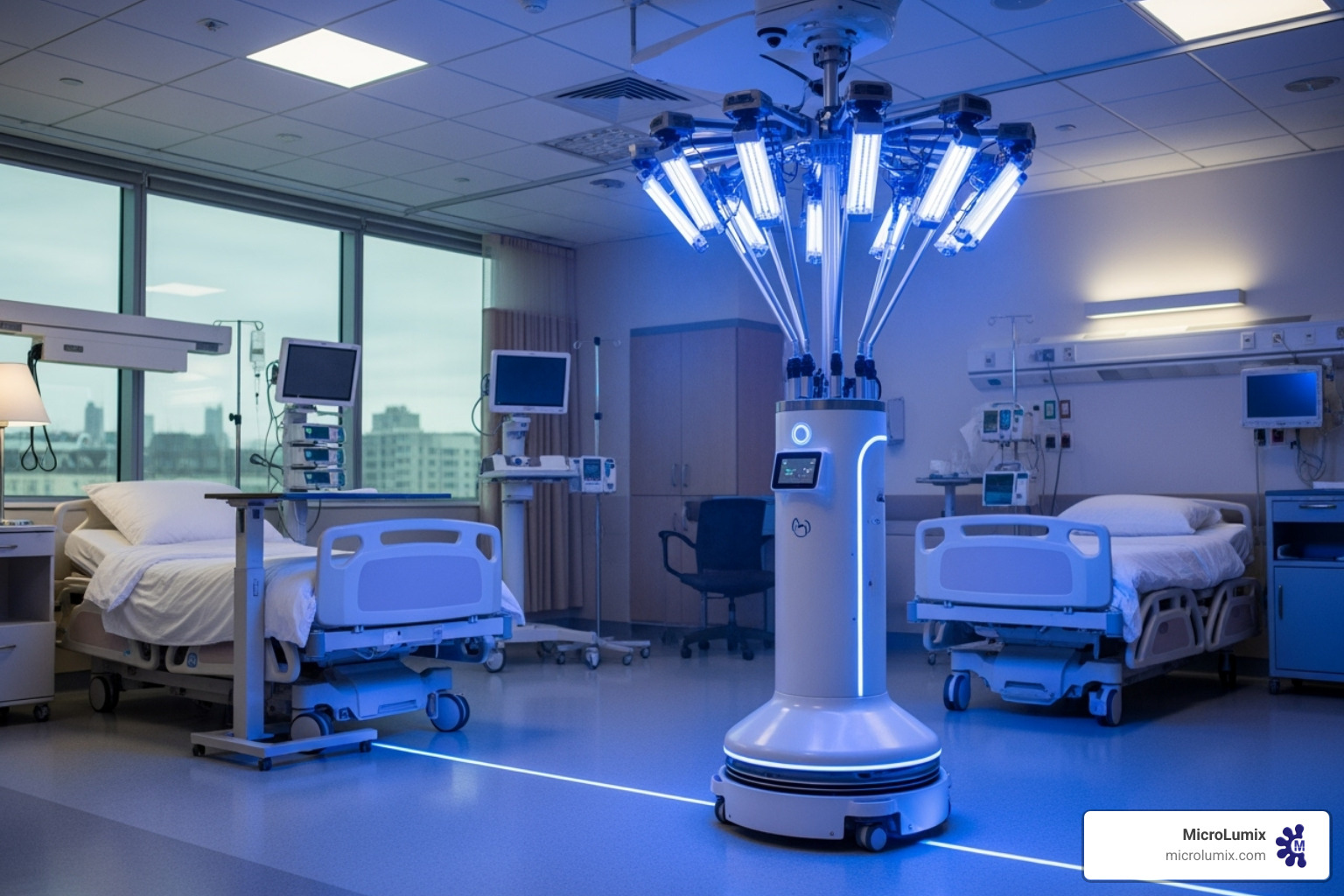
- Surface Sterilization: This is where UVC is most visible. Hospitals use UVC robots to disinfect patient rooms and operating theaters, helping to reduce healthcare-associated infections. In the home, compact UVC sanitizing boxes clean phones, keys, and other small items, while portable wands offer quick surface disinfection, though they require careful use.
At MicroLumix, we focus on an automated approach to sanitizing high-touch surfaces that are often missed by traditional cleaning.
Types of UVC Light Sources
Different UVC sources have unique strengths:
- Low-Pressure Mercury Lamps: The traditional workhorse, these lamps efficiently produce UVC light at the highly effective 254 nm wavelength. However, their mercury content requires careful handling and disposal.
- UVC LEDs: A mercury-free alternative, LEDs are compact, durable, and can be engineered to emit specific wavelengths (e.g., 265 nm, 273 nm). They offer instant-on functionality and improving energy efficiency.
- Pulsed-Xenon Lamps: These deliver intense, broad-spectrum bursts of UVC light. They are powerful and fast, typically used in professional settings for rapid disinfection.
- Excimer Lamps: A newer technology, these lamps can produce far-UVC light around 222 nm, representing a potential breakthrough in safety.
The Rise of Far-UVC: A Safer Frontier?
Far-UVC light, at a wavelength of around 222 nanometers, may solve the biggest challenge of traditional UVC light sanitization: human safety.
Unlike 254 nm UVC, which can damage skin and eyes, far-UVC has a much shorter penetration depth. At 222 nm, the light is absorbed by the dead outer layer of skin and the eye’s tear layer, preventing it from reaching living cells and causing damage.
This key difference opens the door for occupied space disinfection. Imagine UVC light operating continuously and safely in classrooms, offices, and public transit to destroy airborne pathogens. Research shows far-UVC can effectively inactivate airborne viruses while remaining safe for human exposure. This technology offers a glimpse into a future where our shared spaces are constantly sanitized, providing an active defense against infectious diseases.
Safety First: Understanding and Mitigating UVC Risks
While UVC light sanitization is powerful against germs, it poses significant risks to humans if used improperly.

Direct skin exposure to traditional UVC causes erythema, a painful sunburn that typically heals within a week. Chronic exposure may increase the long-term risk of skin cancer.
Eye exposure is the most immediate danger. A few seconds of direct UVC can cause photokeratitis, a painful, temporary condition like a sunburn on the eyeball.
There is also a risk of indoor air pollution. Some UVC lamps, especially those emitting below 240 nm, can generate ozone, a respiratory irritant. Furthermore, UVC can react with common indoor chemicals from air fresheners or cleaners, potentially creating harmful byproducts like formaldehyde.
The FDA has issued warnings about improperly used UV lights, which can be risky or ineffective. This underscores the need to respect the technology and its safety protocols.
Essential Safety Precautions for UVC Light Sanitization
Using UVC light sanitization safely requires following strict rules:
- Avoid Direct Exposure: Never look at UVC bulbs during operation and ensure all skin is covered if you must be near an active system.
- Use Personal Protective Equipment (PPE): When presence is required, use specialized UVC-blocking eyewear and protective clothing.
- Rely on Safety Features: Quality devices include automatic shut-offs, motion sensors to detect human presence, and interlocks that prevent activation unless the device is properly closed.
- Ensure Proper Ventilation: If using a device that may produce ozone, ensure adequate airflow to maintain healthy indoor air quality.
- Follow Manufacturer’s Instructions: Adhere to all guidelines for operation, maintenance, and intended use.
Key Considerations When Choosing a UVC Device
When selecting UVC light sanitization equipment, prioritize safety and effectiveness:
- Reputable Manufacturer: Choose companies with a proven track record in disinfection technology.
- Third-Party Testing: Look for independent lab testing that validates the device’s efficacy claims against specific pathogens.
- Wavelength Verification: Confirm the device emits light in the germicidal UVC range (200-280 nm).
- Dose and Exposure Information: The manufacturer should provide clear data on the UVC dose delivered and the required exposure times.
- Robust Safety Features: Prioritize devices with automatic shut-offs, motion sensors, and interlocks.
- Regulatory Oversight: While the EPA doesn’t routinely assess UVC devices, look for FDA clearance for medical devices and familiarity with standards like BS 8628:2022.
- Match Device to Need: Ensure the device is designed for your specific application, whether it’s surface disinfection, air purification, home use, or healthcare.
Frequently Asked Questions about UVC Sanitization
Here are answers to common questions about UVC light sanitization.
Can UVC light penetrate surfaces or fabrics?
No. UVC light is a surface-level disinfectant and cannot penetrate objects, fabrics, or even thin layers of dust. It only works on surfaces with direct line-of-sight exposure. Any shadows, creases, or blocked areas will remain untreated. This is why effective UVC systems often use reflective chambers or multiple light sources to ensure complete coverage.
How long does it take for UVC to kill germs?
The time needed for UVC light sanitization depends on the UVC dose (intensity and time), distance from the source, and the type of pathogen. For example, a phone sanitizer might achieve 99.9% germ reduction after two 30-second cycles, while inactivating SARS-CoV-2 can take two to nine minutes. However, highly resistant pathogens like C. difficile spores may require up to 45 minutes of exposure from a professional-grade system. Always follow the manufacturer’s recommended exposure times for your specific device.
Are all UVC sanitizers sold online effective and safe?
Unfortunately, no. The market is flooded with products, and many are not effective or safe. The EPA warns consumers to be careful with UV lights, as many consumer-grade wands emit unsafe radiation levels or an insufficient UVC dose to kill germs. Many devices also lack critical safety features like automatic shut-offs or motion sensors. For medical applications, the FDA typically requires clearance or approval. It is crucial to choose products from reputable manufacturers that provide third-party testing data and have integrated safety features.
Conclusion: A Powerful Tool in the Modern Hygiene Arsenal
UVC light sanitization has evolved from a niche technology into a reliable tool in the fight against pathogens. The science is clear: by targeting microbial DNA and RNA, UVC can achieve up to 99.99% efficacy without chemical residues. Its applications in water, air, and surface disinfection deliver consistent, measurable results.
The potential for automation is one of the technology’s most exciting aspects. Automated systems can overcome the human error and time constraints that often compromise manual cleaning protocols.
The future is even brighter with emerging far-UVC technology. The prospect of continuous, safe sanitization in occupied spaces could revolutionize public health.
Of course, UVC light sanitization is not a magic bullet. Its line-of-sight dependency and safety risks mean it must be part of a comprehensive hygiene strategy. When used correctly with quality equipment, it is an incredibly powerful tool.
At MicroLumix, our passion for this technology led to the GermPass system. As the world’s only lab-certified, automatic touchpoint germ-killing system, it uses self-sealing UVC chambers to sanitize high-touch surfaces immediately after use, achieving 99.999% efficacy. This represents the future of hygiene: seamless, automated, and highly effective.
By combining proven germicidal power with smart automation and rigorous safety standards, we are not just cleaning surfaces—we are building a foundation for healthier communities, one touchpoint at a time.